Long before the conversion to Christianity, the Vikings celebrated Yule in December in the lead up to the Winter Solstice and the turning of the year. One of the most important mythological events that was believed to happen around Yule was Odin’s Wild Hunt, known as Oskoreia, Odens jakt (Odin’s hunt), or Asgardreien (Asgard Ride). The symbology of the hunt may have inspired aspects of Santa Claus as his sleigh. We have discussed in previous articles how Odin inspired Santa Claus.
Odin’s Flight
![Asgårdsreien [The Wild Hunt of Odin] (1872) by Peter Nicolai Arbo](https://blog.vkngjewelry.com/wp-content/uploads/2025/12/Wild-Hunt.jpg)
According to folklore, Odin led the wild hunt in winter, probably an ideal time because the veil between the worlds was considered to be at its thinnest. Normally, Odin collected the souls of the bravest fallen warriors, with the help of his Valkyries, to take to Valhalla. But during the hunt, be collected other things that had died throughout the year, clearing the way for new growth as the days started to get longer.
While this was positive, the Vikings spent the period of the hunt indoors, making sacrifices so that they would not be caught outside while the hunt was overhead and be taken away by accident. It may have been quite common for travelers to go missing at Yule due to the harsh winter conditions in Scandinavia.
For this reason, Odin’s hunt was not seen, as people avoided being outdoors. However, it could be heard, as he was accompanied by two dogs, one of which barked louder than the other. Hearing these barks was taken as a sign that the hunt was near. It is possible that these “dogs” were imagined to be Odin’s familiar wolves, Geri and Freki. Stories from Smaland also suggest that Odin hunted with large birds, perhaps representing his familiar ravens.

However, while abroad, Odin could also choose to visit the worthy and deliver presents and good fortune. It is unclear whether this aspect of the hunt belonged to pagan times or was introduced after the conversion to Christianity.
As time went on, the western Swedes suggested that the leader of the hunt was a king who had hunted on Sundays, the Christian day of rest, and was therefore doomed to hunt down and kill supernatural beings for all eternity.
Finding Folklore
The concept of the Wild Hunt was first documented by the German folklorist Jacob Grumm in the early 19th century. He connected the hunt with Odin, who threw off his usual characteristics and adopted a darker specter and an almost devilish character.
Grimm suggested that sometimes Odin was replaced by a female figure called Holda and Perchta. We have talked about Perchta before, because she is related to the Germanic figure of the Krampus.
Perchta and the 12 Days of Christmas
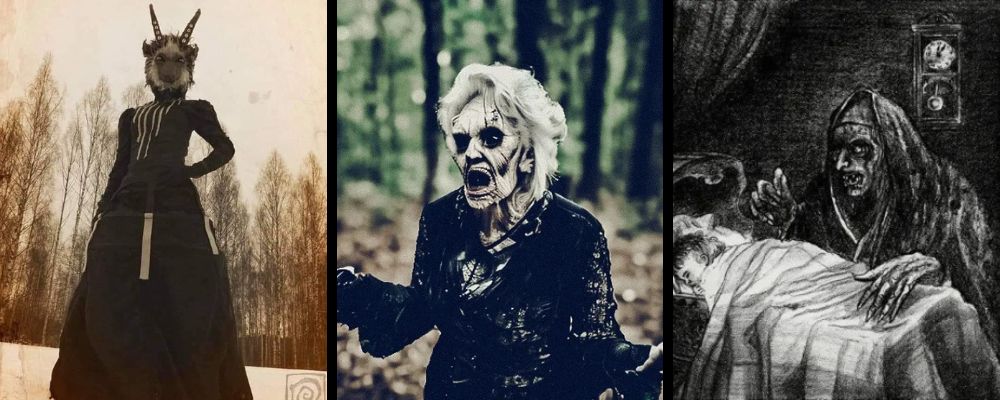
Perchta was a goddess of the Alpine regions believed to be linked to the Norse gods Frigg or Freyja, either of whom would seem like reasonable figures to accompany Odin on his hunt, Frigg as his wife and Freyja as another collector of dead souls.
Perchta means “bright one” or “light bearer,” and she was the patroness of spinning and women’s work. But she seems to have had a dual nature, being represented as a glowing and beautiful figure in all white, but she could become an elderly and haggard woman around Yule. This “ugly Perchta” was the mother of beasts collectively known as the Perchten.
By Christian times, Perchta and her children had become associated with the 12 days of Christmas. Visiting homes in the lead up to Christmas, she would assess the work of children and young servants, ensuring that they had been sufficiently productive over the last 12 months. Plus, she would enforce the rule that spinning was prohibited during the holiday period.
Those who had done well would receive a silver coin in their shoe or pail. Those who did not do well received an unpleasant gift, or could have their bellies cut open, their stomachs and guts removed, and replaced with straw and pebbles.
In Iceland, this same figure became known as Gryla by the 17th century, and she was believed to have been a vagrant woman who asked people to give her their mischievous children to eat. She was eventually driven out of the community and became a troll. Gryla returns at Yule to kidnap misbehaving children to satisfy her desire for their flesh.
She was accompanied by her 13 prankster sons, one showing up on each day in the 13 days leading up to Christmas, and staying for 13 days each, which meant that they were around until January 6th, the 12th day of Christmas. Each liked to make mischief in their own way.

- Stekkjarstaur means “Sheep-Cote Clod” and he makes trouble by harassing herds of sheep.
- Giljagaur means “Gully Gawk” and he hides in gullies and steals milk.
- Stufur means “Stubby” and he is abnormally short and steals pans to eat the crusts left behind.
- Thvorusleikir means “Spoon-Licker” and he steals and licks wooden spoons. He is thought to be very skinny since this is not a very good form of sustenance.
- Pottaskefill means “Pot-Scraper” and he steals the leftovers from pots.
- Askasleikir means “Bowl Licker” and he hides under beds and waits for people to put down their bowl so he can steal it.
- Hurdaskeller means “Door-Slammer” and he slams doors especially at night to wake people up.
- Skyrgamur means “Sky-Gobbler” and he steals skyr, which is like yogurt.
- Bjugnakreakir means “Sausage Swiper” and he hides in the rafters and snatches sausages that are being smoked.
- Gluggagaegir means “Window-Peeper” and he looks through windows in search of things to steal.
- Gattathefur means “Doorway-Sniffer” and he has an unusually large nose and uses his sense of smell to locate leaf bread.
- Ketkorkur means “Meat-Hook” and he uses a hook to steal meat.
- Kertasnikir means “Candle-Stealer” and he follows children to steal their candles.
While this might sound like a villain line-up for a Christmas horror-comedy, they were seen as a genuine threat to children.
The Wild Hunt in Other Traditions

Cultural exchange over the centuries means that we also see the Wild Hunt in other traditions.
It is mentioned in the Peterborough Chronicle, claiming that it appeared in 1127. It claims that the huntsmen were seen overhead, black, huge, and hideous, riding black horses and goats, with jet black hounds. They say that there were 20-20 huntsmen, and they were seen repeatedly over the course of nine weeks, starting at Christmas and ending at Easter.
In the medieval period, the hunt was portrayed as demonic, with the hunters described as fairies led by a variety of figures from King Arthur to the Devil himself.
One story suggests that there was a hunt led by a man called Dando, who was incredibly thirsty but had no water. He claimed that he would go to hell in exchange for a drink. A stranger showed up and offered Dando a drink, which he accepted, and then took off with Dando’s game. The hunt went after him and was led into hell.
A Yule Tradition

While Yule was a period of celebration in the Viking world, as people came together to brave out the winter and celebrate the start of days getting warmer and longer, it was also a dangerous time. The harsh weather meant that it was dangerous to be abroad, so it made sense that they believed that misfortune could easily befall anyone caught abroad.
Yule traditions became associated with Christmas traditions when, according to the Saga of Hakon the Good, King Hakon I of Norway changed the traditional date of Yule to coincide with the new Christian festival of Christmas, aligning old and new customs.