The Vikings generally had a good diet, rich in animal proteins and much less reliant on grains than their southern neighbors. This is one of the main reasons why the Vikings were on average several inches taller than the English and the French, and why the English sometimes referred to the Vikings in England as fat and gluttonous in comparison to themselves.
Feasting was an important custom in the Viking world that brought communities together and reinforced social ties and obligations. One of their most important annual feasts was Yule or Jul, which lasted for 12 days in December, the height of winter. But this feast was held during a time of food scarcity, so what did the Vikings eat during their winter festivals?
Farming, the Harvest, Preservation

At the height of the Viking Age, communities were focused on small farms that could support extended families. Even people with other professions, such as blacksmiths or traders, probably had a farm to retreat to in the winter months that was maintained throughout the year by family members, especially women, paid help, and slaves. This structure also meant that poorer Vikings had places to stay in the winter.
More itinerant Vikings, such as wandering Volva witches, might visit larger farms during the winter months, where the customs of hospitality meant that they were welcome. They were fed and kept safe from the winter cold, and in exchange would perform spells, make predictions, and conduct rituals for good fortune.
Food was plentiful in the Autumn when food was ready to harvest, so Alfablot, celebrated around the same time as Celtic Samhain and modern Halloween, was the biggest feast of the year with the best food. The Vikings also dedicated much of the harvest season to preserving food for the long winter months. It was these preserves that served as the basis of Viking winter feasts.
Protein: The Main Dish

Based on the written sources, mostly from after the Viking age, and archaeological evidence from decomposed deposits, port holes, fireplaces, and waste layers, plus analysis of human remains, the Vikings had a very protein-rich diet.
Most farms had a few cows, which were often slaughtered after they had their calves, though some seem to have lived for as long as ten years, suggesting that dairy was also important, though goat milk and cheese may have been more common.
Farms also had oxen, pigs, sheep, chickens, and ducks, which means that eggs were also important to the diet. In addition to farm animals, the Vikings hunted wild game and also ate a lot of fish, which may have been as much as 30% of their diet.
Meat had to be preserved so that it could be available in the winter. Meat could be dried, smoked, or salted, with the latter being the most common practice. This meant that the meat tasted very salty. For this reason, meat was usually boiled in stews that reduced the concentration of salt, and the broth was also excellent for dipping bread. This, or drinking it straight out of the wooden bowl, was pretty much the only way to eat the broth since utensils had not yet become common.
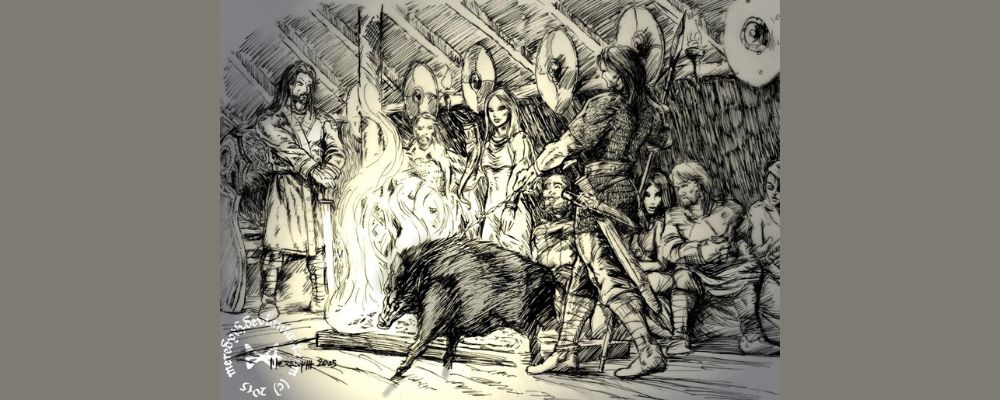
On special occasions, such as Yule itself, an animal that had been kept alive for the purpose was often killed and roasted. This was usually a pig, but it could be a goat.
It was common for men to swear oaths of loyalty on the prized roast pork. In the Helgakvida Hjorvardssonar, in the hall of a Norwegian king on Yule eve a sacred boar was brought out and the men present laid their hands on the animal to swear their oaths to the king. Similarly, another king sacrificed the biggest boar that he had to the god Freyr on Yule Eve, and again, men laid hands on its bristles to swear oaths.
Side Dishes

The Vikings ate plenty of vegetables, including cabbage, onions, garlic, leeks, turnips, peas, and beans. These were often roasted in butter, which was good for preservation, and again could balance the taste of the salt used for preservation.
They also collected greens and herbs, such as nettles, bocks, cress, dill, parsley, mustard, horseradish, and thyme. These would have been the flavors that characterized the dishes eaten during the winter feast.
There were also sweet treats such as sweet fruits, dried nuts. Nothing like modern deserts since sugar was not available. The only sweetener was honey, and it was relatively hard to come by, so it was used sparingly.
Drinks
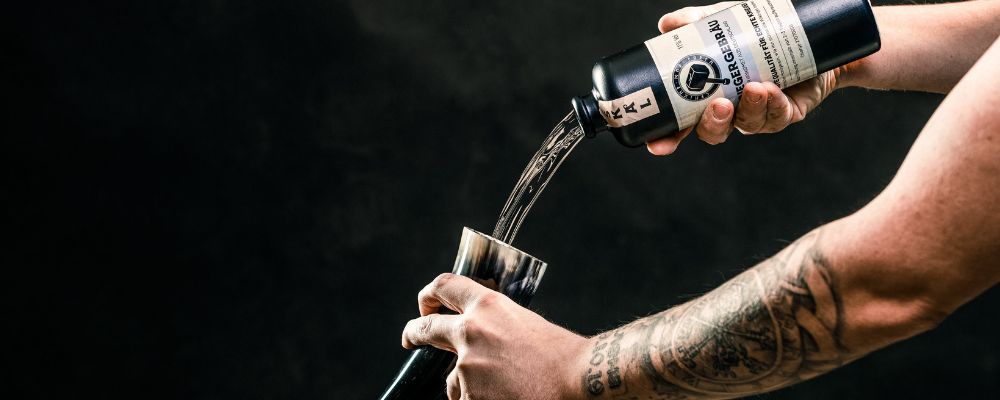
Lots of booze was imbibed during winter feasts. This wasn’t just because of the festive atmosphere, but because brewing was one way to make questionable water sources safe to drink.
Mead was a popular drink, made from honey, so often reserved for special occasions such as feasts. While there are no bees in Scandinavia today, it was warmer in the Viking age, so there may have been more around, but honey was still probably not an abundant resource.
Mead was brewed by individual households, along with beer and wine, so home brewing kits would have made a nice Yule present.
Longhall Festivities

While many winter feasts would have taken place in the home, as communities grew, the Yule feast was often hosted in the longhall of the local leader.
Generally speaking, the longhall circled around a space in the middle where a fire pit was located to provide warmth to everyone in the building. Raised wooden platforms or benches then lined the long walls, which were the main places to eat and sleep. Straw, furs, and similar items would have been placed around to make these seats more comfortable and a bit warmer.
Benches were intersected by ondvegissulur, which are pillars or posts that were not part of the structure of the longhouse but set up to honor the gods. We know that Norwegian settlers sailing for Iceland brought their ondvegissulur with them, and when they sighted land, threw them into the water. They then built their homes where the posts washed ashore, assuming these places were favored by the gods.
There was hierarchy in the seating arrangement, with the chief sitting in what was known as the hasaeti or high seat, his closest allies sitting on the aedri, and less important guests sitting on the oedri. These seats probably weren’t at different heights, but were at specific locations in the longhall, and then in relation to the chief. The chief would also have led the rituals undertaken to honor the gods.