I was recently asked whether the Celts had a version of Valhalla.
The simple answer is no, since Valhalla emerged from the old Germanic religion, and the Celtic religion had a different root.
But they did have an idea of an Otherworld, where the divine and the dead meet.
That is not unlike Valhalla, where brave fallen warriors live alongside the gods.
Characteristics of the Otherworld

The Otherworld is described differently in different Celtic traditions, which we will look at more below, but there are several consistent features.
The Otherworld exists alongside the mortal realm, either beyond a supernatural veil that can be crossed in the right circumstances, or across a distant sea.
Places such as burial mounds and bodies of water, like lakes, are often seen as portals between the mortal world and the Otherworld.
The realm is inhabited by the gods and fair folk, who enjoy endless youth, abundance, and happiness in this realm.
However, the dead are also often described as passing over into this realm, and it is often unclear whether they become the fair folk.
It is often suggested that this is a temporary dwelling place before being reincarnated into a new mortal life.
Interactions between the two realms are fairly common. Mortals can be invited to the Otherworld, and fair folk and ancestors can visit the living, though only temporarily.
There is often an implication that the worlds are fundamentally different, with time for heroes passing either much faster or much slower for those in the Otherworld.
While most stories of visits to the Otherworld involve heroes and warriors, there does not seem to have been a “test” for entry, as we see for Norse Valhalla.
Early Celtic Otherworlds

Evidence for the Celtic belief in the Otherworld dates back to at least the 1st century BCE, when the Greeks and Romans recorded observations about the Celts living in Gaul and elsewhere.
However, since these observations are recorded by outsiders, they can’t be taken at face value, as the Greco-Romans were interpreting what they saw through their own lens of understanding.
They observed that the Celts divided the universe into three realms: Albios (the heavens), Bitu (the mortal realm), and Dubnos (the black world), paralleling their own division of the cosmos into Olympia, Earth, and Tartarus.
In addition to this, according to the Roman poet Lucan, the Celts believed that upon death the soul passed to an Otherworld, which he called “orbis alius” (another world) prior to being reincarnated.

The Romans also spoke of Celtic sacred isles that were dedicated to the gods, but did not seem to consider them solely the domain of the divine, as they identified Anglesey (Mon) off the north coast of Wales as one such sacred isle, and it was occupied by the Druids, the Celtic priests.
The Greek scholar Procopius suggested that the Celts believed that the Otherworld lay in the west, beyond the coast of Britain, and that the dead souls travelled there in ships.
During Roman occupation, there also emerged a god called Sucellus.
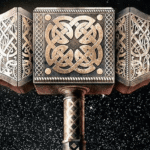
He was associated with agriculture and wine making, and was often depicted with a hammer, not unlike Thor, and ravens, not unlike Odin.
However, he also had a Chthonic aspect, maintaining the boundaries between the worlds of the living and the dead, and sometimes guiding the dead on their journey into the Otherworld.
He is also sometimes associated with Dis Pater, who was the progenitor of the Gauls, according to Caesar.
This would seem to point to a connection between the divine world and the afterlife and beliefs around reincarnation.
Gaelic & Brittonic Otherworld
In Gaelic and Brittonic myth, it is a supernatural realm located beyond the sea or under the earth where supernatural beings enjoy everlasting youth, health, and abundance.
While it is a divine realm, several heroes have visited the realm, and its inhabitants sometimes visit the mortal realm.
Irish Mythology

In Irish mythology, the Otherworld has various names but is most often called Tir na nOg, again meaning “land of the young.”
Very similar to the Gaelic Otherworld, it is specifically seen as the dwelling place of the gods, called the Tuatha De Danann, but certain heroes and important ancestors also find themselves in the Otherworld.
The supreme ruler is almost always identified as Manannan mac Lir.
Described as either a type of parallel universe or a land beyond the sea, in both traditions, the mortal world and the Otherworld sometimes meet.
The veil between the worlds is particularly thin at important times of year, such as Samhain and Beltane.
Burial mounds were also seen as portals between the worlds, reflecting the belief that it was both a divine world and an afterlife.
This is not a contradiction, as the Celts had a clear idea of divinized ancestors.
The idea of portals between the worlds also makes sense in terms of broader Irish mythology.
It says that the Tatha De Danann settled Ireland, taking it from the Fir Bolg, and were then driven out by Milesians, making their home in the Otherworld.
Mortals are sometimes invited to visit the realm by its inhabitants.
They tend to arrive by entering through a burial mound or cave, journeying through a mist, going underwater via a pool or lake, or traveling across the sea for three days in an enchanted boat.
Welsh Ideas

In Welsh mythology, the Otherworld is called Annwn, and it seems more like an underworld as the survivors of great battles are described feasting there, though the realm is ruled by the god Arawn and is the dwelling of the Gwyn ap Nudd, who are the fair folk, who are not always easy to distinguish from deified ancestors.
Like its parallels, it is a land of eternal youth and abundance.
While the etymology of the name may be suggestive of an underground world, meaning “very deep,” it is usually described as a distant and mythical island.
It plays a significant role in the Four Branches of the Mabinogi, which are early Welsh prose, and then finds its way into Arthurian legends.
In one myth, a prince called Dyfed offends Arawn, the ruler of the underworld, and is forced to exchange places with him for a year in recompense.
While in the otherworld.
Dyfed defeats Arawn’s enemy Hafgan and also abstains from sleeping with Arawn’s wife, earning him Arawn’s gratitude and friendship for when he returns to the mortal realm.
Another story, Cad Goddeu, describes a war between the mortal Gwynedd and the forces of Annwn. Interestingly, the army of Annwn is described as bizarre and hellish creatures, including beasts with a hundred heads, and a serpent holding a thousand tortured souls within its skin.
Thanks to the hero and magician Gwydion, the army of Annwn is defeated by enchanting the trees to rise up and fight against them, and then guessing the name of his enemy.
Since the text preserving the poem dates to the 14th century, the introduction of hellish elements could represent Christian influence, demonizing this supernatural realm as hell.

In another poem, Preiddeu Annwfn, King Arthur is described as visiting numerous otherworldly kingdoms on his quests.
It is presented as a dangerous land as Arthur sails there with three boats of men and returns with just seven, though how they died is not explained.
This later morphs into Avalon in accounts of the Arthurian legends. King Arthur is sent there to recover from his wounds after the Battle of Camlann, but he never returns to the mortal realm.
It is also where Excalibur was made and presented to him by the Lady of the Lake through a watery portal between the realms.
The Celtic Afterlife
Overall, the afterlife is less clearly articulated in surviving Celtic mythology than in Norse mythology.
What is clear is that the Celts believed in a supernatural realm beyond their own, but which was connected with the mortal world.
This is where forces that are felt but are unseen dwell, including both the gods and lost loved ones.
They seem to have imagined this realm, best characterized as the Otherworld, as very similar to their own, ruled by kings who waged wars.
But in other ways, it was idyllic, without aging, death, famine, and the other things that people of the day feared.
While we could pick through and identify many similarities with Norse ideas of the afterlife, many of these ideas are universal as humans struggle to come to terms with the question of what happens to us after we die.