When restoration work was underway at Pitney Church in Somerset, England, in 1853, excavators found a fine gold-gilded bronze brooch that appeared to date to the Saxon era. It was quickly named the Pitney Brooch.
Examination at the British Museum revealed that while the brooch dated to the Saxon era in England, specifically the second half of the 11th century, its design was Norse and reflected the strong Viking presence in England at the time. This was the period right after Sweyn Forkbeard became the first Viking king of England. Moreover, it was identified that the Pitney Brooch reflected the same motifs seen on many Norse artifacts from the era, but it is by far the finest surviving example.
This is why the Pitney Brooch has inspired our designers to create a piece for our Heirloom Collection.
The Pitney Brooch

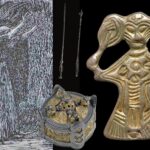
The Pitney Brooch is a disc brooch made from copper alloy and gilded in gold. This suggests that it was probably a brooch used to secure clothing, in typical Viking style, belonging to a member of the local Norse elite, to afford such a fine piece.
The brooch displays an intricate design of ribboned animals, popular in both Norse and Anglo-Saxon art. It shows a quadrupedal animal with a highly elongated body that coils like a ribbon to form an elaborate pattern, in this case, forming more or less a heart shape. Its body is a mix of plain and bearded bands. It ends with spiral hips with sharp, angular feet with three toes.
The animal is locked in battle with a snake, whose ribboned body also forms elaborate patterns. It bites the other animal on the neck as it stares out directly with two large eyes. Its tail also ends in two spirals.
This brooch shares significant similarities with another brooch found at Wisbech in Cambridge, but the Cambridge example, made in bronze without the gilding, is much simpler in design and not executed with the same skill. This shows the difference in quality of the jewellery worn by elites and others.
Scandinavian Style

Despite two similar brooches surviving from England, the Pitney Brooch does not bear a close resemblance to Saxon jewellery of the time. Instead, it seems to clearly have been inspired by Scandinavian art, specifically the Urnes style.
The Urnes style, which flourished in Scandinavia between around 1050 and 1125, is named for the carved wooden door of the northern gate of the Urnes Church in Norway. It shows the same ribboned animals locked in the same conflicts, and shares design details with the Pitney Brooch, such as the lentoid eye of the quadrupedal animals and the S-shaped lappet of its jaw.
While this is the piece that gives the art style its name, several examples survive from across the Viking world. For example. The Jelling Runestone, erected by Harald, king of Norway, for his father Gorm and mother Thyra, uses the same design. In this case, the quadrupedal animal seems to be a lion, but this is hard to confirm, especially since lions were not common animals in the Viking world. The same style is also seen on a silver bowl from Lilla Villa.
Artistic Emulation

Interestingly, we see the same kind of brooch design imitation in Scandinavia as we see in England. An 11th-century fine brooch in silver with the same motif was found at Lindholm Hoje, a Viking burial site near Aalborg, Denmark. It seems clear that this brooch served as a model for several bronze copies produced from a mould at Lund in the 12th century. This suggests that copying designs was a common Viking practice at the time.
We can also track a connection over the sea. Several of the Linsberg Runestones, from Sweden, share the same artistic features. One example, 344, which was found at Yttergärde, repeats the motifs and includes an inscription that Ulf of Borresta had taken three Danegelds in England. This suggests that he was one of the Vikings active in England in the 11th century and confirms a connection between the parts of Scandinavia where the Urnes style was popular and England.
Motif with Meaning

What are we supposed to assume from the motif? Without written evidence, this can only be guesswork. However, it seems reasonable to assume that the serpent in the image is a reference to one of the two great serpents in Norse mythology, or serpents in general, whose characteristics were embodied in these examples.
Firstly, the serpent, or dragon, since the Norse did not distinguish between the two, Nidhoggr lives entangled in the roots of the world tree Yggdrasil. He gnaws on the roost constantly, causing the backbone of the universe great pain. This explains the entanglement theme, but not the other animal.
The other great serpent in Jormungandr, one of the children of Loki with the giantess Angrboda. The gods so feared the serpent that they threw it into the ocean surrounding Midgard. There, it grew to such an enormous size that it can surround the earth and hold its own tail in its mouth. Jormungandr, of the Midgard Serpent, is only destined to leave the ocean at Ragnarok, when he will fight to the death with Thor. While Thor will defeat the serpent with his hammer, it will spew so much poison onto the god that he himself will die within seconds of completing the combat. In this way, Jormungandr represents a battle that must be fought and a fate that cannot be avoided.
Again, it is not clear what animal is fighting with the serpent. While some visual analyses suggest that it may be some kind of lion or feline, Norse myth suggests that a wolf or a bear would be more appropriate.
Own a Piece of the Past

Are you inspired by the incredible piece of history that has made its way into the modern day? Despite being diminutive in size (just 39mm in diameter and 15g), it has revealed much about the Viking world. If it speaks to you, then you can own your very own with our Pitney Ring.
Our expert craftsmen have replicated the design as a silver signet ring. The brooch design serves as the signet and has a gold-plated overlay, just like the Pitney ring. The rings itself is also decorated in Urnes style, remaining true to the artistic sentiments of the day.
The Pitney Ring is part of our new Heirloom Collection. Every piece is inspired by a genuine piece of jewellery, worn by our ancestors and preserved in the archaeological record.