The Vikings began raiding the coastal regions of France at the end of the 8th century, at around the same time that they started raiding in England. Just as in England, the scale of their raids grew over time.
Five thousand Vikings, under the leadership of a chief named Ragnar, sacked Paris in 845, and then besieged the city again in 885.
At around the same time, a Viking chief named Rollo took the territory around Bayeux by force.
He had his position recognized by the French king, and his descendants became the Dukes of Normandy.
The Vikings had a significant impact on France in the 9th and 10th centuries, but, when compared to England, very little archaeological evidence survives for their presence.
There are several reasons for this, such as the law against metal detectors.
Nevertheless, there are a few extremely interesting finds, especially when they are placed in the context of the plentiful historical sources, such as Medieval chronicles, monastic records, and royal annals.
Let’s take a look at some of the important Viking archaeological evidence in France.
Camp de Peran : Viking Fortifications

Camp de Peran is a partially excavated earthwork in northern Britanny that looked out over the Urne and Gonet Valleys.
The fortifications have been dated to the 10th century by surviving pottery and a coin of Saint Peter minted at York sometime between 905 and 925 CE.
This coin from Viking Jorvik, along with fragments and a metal helmet and the ferrule of a lance that seems to have Norse origins, suggests that this was a Viking site.
The site is relatively well preserved through vitrification, caused by a fire that consumed the site.
This destruction has led historians to link the site to the Viking occupation of Brittany between around 907 and 939 CE.
According to the Chronicle of Nantes, this forced Allan II, Duke of Brittany, to flee to England and take refuge with King Athelstan.

The Vikings, led by a Dane called Halstein, conquered the area in 907.
In 931, these Vikings assembled an army on the Lire River to launch an attack across the river against the Franks.
As the Vikings were distracted, the local Bretons used the opportunity to revolt, unsuccessfully.
But the Vikings were sufficiently weakened that Allan returned to Britanny to retake his territory in 936.
He had a definitive victory at the Battle of Trans-la-Foret on August 1, 939, during which he reportedly decisively attacked a Viking stronghold, probably Camp de Peran.
L’Ile de Groix : Viking Ship Burial

A ship burial was discovered at L’Ile de Groix off the south coast of Brittany in 1906.
It shared many characteristics with Norwegian ship burials and is the only cremated ship burial found outside Scandinavia.
The burial mound sits overlooking a small, sandy bay, which is the only suitable landing spot in that part of the island and is easily visible from a great distance.
The boat was 2.5 meters wide, which suggests that the original boat was about 15 meters long.
More than 800 rivets have been found, suggesting that a smaller ship was buried alongside the larger ship, as seen in several Norwegian cases.

Around the mound, which was five meters high and 20 meters in diameter, was set near an area of 17 meters marked out by four vertical stone slabs, and further slabs were arranged in a line leading off to the southwest.
These may have marked the path by which the ship was brought up, or the path of the funeral procession.
The ship has been dated to around 950 and contained the remains of two men, one mature and one adolescent.
This, along with the richness of the burial, suggests that this was the burial of a Viking noble with an attendant or slave.
Several dogs and birds were also found in the grave.

The burnt material of the grave formed a deposit 145 centimeters thick covering an area about five by six meters.
It shows that the grave contained weapons, riding gear, jewelry, tools, vessels, playing pieces, and agricultural implements.
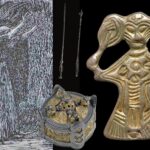
The grave contained one object of particular interest. It provides the only known example of a stern ornament from a Viking ship, though several vanes survive.
It includes a metal band 60 centimeters in diameter with leaves and movable rings around its edge.
It probably formed a dragon’s tail, like the one depicted on the runestone from Stenkyrka on Gotland.
Ile de Re : Viking Graves

The last major Viking archaeological site in France is a recent find in the village of La Flotte on the Ile de Re off the western coast of France, where excavations started in December 2024.
Archaeologists have found about 50 graves dating from the 8th century to the 15th century.
There is a significant group of Carolingian-French 8th to 10th century graves typical for the era, simple inhumations covered in wood or stone structures.
However, there are a number that stand out as unusual.
Christian burials at the time were highly uniform, with bodies laid on their backs with legs extended, oriented west to east.
However, there was one grave with the person lying on their side with bent legs, another buried face down, and a third bent with raised limbs.
The last two were also oriented south-southwest.

In contrast to most of the graves, a few also had grave goods typical of Norse graves.
These include a comb made from bone and antler and decorated with geometric designs, beads of amber, glass, bone, and copper, a folding knife, and a copper alloy belt featuring interlaced decorations.
These objects are all typical of graves in the North Sea area.It is still unclear whether these represent traders or immigrants who were integrated into the local population but still retained some of their own traditions, or members of the local elite who had adopted Norse customs.
Considering the movement of the Vikings through this region of France in the 9th and 10th centuries, either is possible, as they were clearly very present.