It has been a big year in Scandinavian archaeology, with several enormous hoards discovered, notably in Denmark. But now it is Finland that has revealed a massive silver hoard. What’s in the hoard, and what other Viking-related archaeological finds has Finland revealed?
Finland in the Viking Age

Before jumping in, it is worth remembering that Finland was not a central part of the Viking world. It was an ethnically and culturally distinct region more connected to the Baltic and Russia in the east than the surrounding Viking nations. Only the Åland Islands were culturally and linguistically Norse and served as a link to the Viking world. The Finns mainly traded valuable furs to the Vikings in Exchange for silver and brass.
Finland was mostly occupied by the Finns, a Finnic-Urgic people, and the Sami. The harsh conditions meant that communities tended to be smaller and isolated. They also retained their traditional religion for centuries after the Vikings converted to Christianity.
The Sysmä Hoard

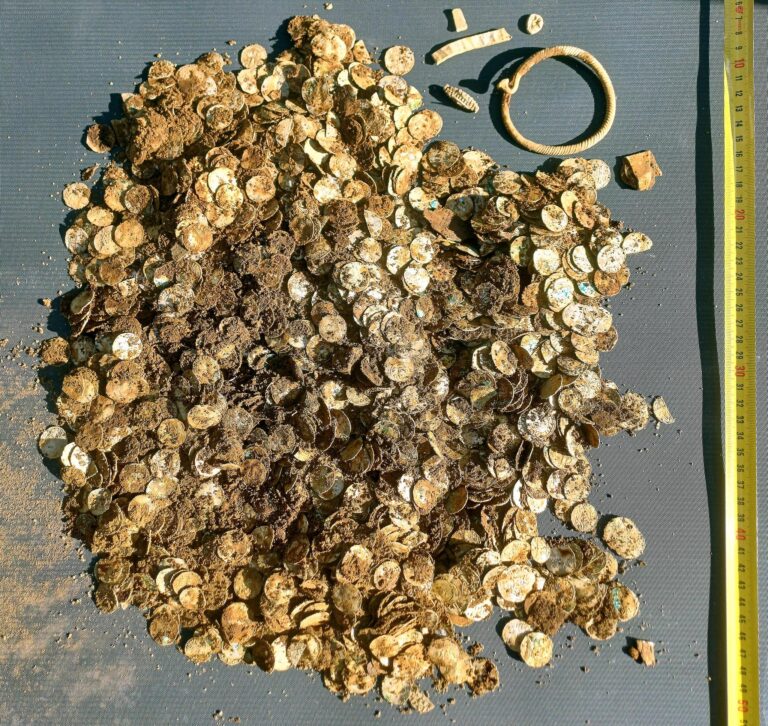
The new hoard was discovered near the Sysmä church village in southern Finland. The first coins were discovered by metal detectorist Kalle Lappinen in early September. He reported the find, and a team from the local museum continued excavations. They have recovered thousands of silver coins, silver fragments, a silver bracelet, a silver clasp, and one silver bead. In total, the hoard weighs around 4.5kg/10 lbs.
While the coins have yet to be cleaned and officially counted, this will certainly be the largest hoard ever found in Finland. The previous record holder was found at Nousiainen in 1895 and had 1,700 coins and small objects, weighing around 2.2 kg, so it was about half the size of this latest hoard.

The hoard was buried in a pair of birch bark containers and buried about 18 inches beneath the surface, around 12 meters/40 feet away from each other.
While the coins still need proper examination, the hoard likely dates to AD 100-1050, so the height of the Viking Age. The next phase of archaeological work will focus on determining what the area was used for and by whom in the 11th century.
Viking Swords and Weaponry Found in Finland

While Finland may not have strictly been Viking territory, several important Viking artifacts have been found there over the centuries. Most notably, Finland has yielded one of the highest densities of Viking Age swords in Europe relative to its population, mostly found in graves.
The Suontaka Sword is one of the most famous Viking Age weapons, featuring a cast-bronze hilt decorated in the Norse Urnes style. A 2021 DNA study showed that the person the sword was buried with likely had Klinefelter syndrome, a condition that occurs when a person is assigned male at birth but has an extra copy of the X chromosome. It randomly affects about 1 in 500 males and can result in features such as being taller than average, reduced muscle mass and strength, less facial and body hair, and reduced fertility. This grave raises questions about how this person was treated by their society. Their burial with a sword suggests they held the status of a warrior.

A few famous examples of Ulfberht blades have been found in regions such as Satakunta, Tavastia, and Southwest Finland. These were high-carbon cruciform and pattern-welded blades imported from Frankish workshops and popular among the Vikings from around the 9th century AD.
Scandinavian-style silver-inlaid spearheads and broad-bladed battleaxes have also been found in Finland.
Norse Jewelry

In addition to the silver arm ring discovered in the recent hoard, several impressive pieces of Viking jewelry have been recovered from Finland.
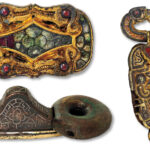
Viking-style brooches used to secure clothing have been found across Finland. As well as imports, Finnish metalworkers produced their own distinct cast-bronze variation with local zoomorphic and geometric patterning.
A particularly well-preserved pair of concave brooches was found by a metal detectorist in 2021 at Töykänmäki in Paimio. They were found alongside two chain-holders and ten pieces of chain links.

Pendants were also a popular piece of jewelry, often featuring birds, similar to Viking styles, which often featured birds of prey or the ravens of Odin. A Permian three-headed eagle pendant was found in Laukkao in Vesilhati.
Graves have also yielded glass mosaic beads, Baltic amber beads, and imported Scandinavian silver pendants.

Probably the most important Finnish find is the Luistari burial ground in Eura, which has over 1,300 graves dating from AD 500-1200. Grave 56, belonging to a woman around 45 years old when she died. She was 165-170 cm tall, making her quite tall for the early 11th century AD.
Her grave is remarkably well preserved, including some rare textile fragments. She was buried with a necklace made with 34 glass beads, silver pendants, and 11 coins, including Arab dirhams and a German coin from Augsburg. Wearing imported coins as jewelry was a common Viking practice, especially in Sweden.
She also wore a pair of dome-shaped shoulder brooches with dangling chain devices adorned with small bells and a symmetrical chest brooch. She had twisted bronze bracelets, finger rings, an iron knife with a feline-fur and deerskin sheath, shears, a sickle, and a broken clay vessel.
Axe of Ukko

While the Vikings venerated Thor, the god of thunder, and wore Mjolnir hammer pendants as symbols of the god’s protection, the Finns worshipped Ukko. He was the sky father and god of thunder in Finnish mythology, and he also wielded a weapon, a hammer called Ukonvasara. The Finns also wore boat-shaped hammer pendants as religious symbols, and many have been found across Finland.
If you are a fan of Finnish history and religion, you can find Ukko hammer pendants in the VKNG collection.