Belts, a very useful accessory, have been around since ancient times. They have been worn since the Bronze Age (c. 2000 BC), and those worn by the Greeks and Romans would look familiar today.
The Vikings also wore belts that would not be too out of place in a modern wardrobe. The belt itself was usually thin, between 1.5-3 cm in width, and was made from leather of woven wool. They were usually held in place by a three-piece metal set, which included a D-shaped or rectangular buckle, a strap end, and a slide to secure the excess of the belt. These pieces were usually made from a brass alloy such as bronze.
While many belt pieces survive in Viking graves, it is not always simple to determine whether they belong to a belt worn by a man, or a woman, or to something like a bridle, which used the same kinds of fastenings.
Utility Belts vs Status Symbols

Belts were worn functionally to carry essential items, usually a knife, a small axe, and a leather pouch for essentials such as coins, a comb, and gaming pieces.
But, as with most Viking ornamentation, belts were also worn as status symbols. A good quality belt was a reflection of you wealth and success, and examples with gold and silver ornamentation are known from richer graves.
Buckles were also often decorated with Norse symbols that were meaningful, or at least appealed to, the wearer. Gripping beast designs, popular in Norse art, were common, as were symbols, such as ravens, serpents, and human faces.

New VKNG Belt Buckles
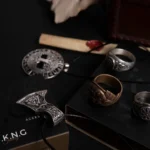
Inspired by the useful but beautiful buckles worn by our Viking ancestors, VKNG has released a series of Norse belt buckles. Like those of the Viking Age, they are also made from brass and feature important Norse symbols.
Viking Mjolnir Brass Belt Buckle

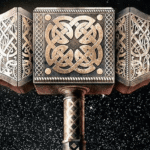
This buckle features a Mjolnir symbol, also known as Thor’s Hammer, inspired by a genuine pendant found at Scania in Sweden. Mjolnir pendants were worn in the Viking age as symbols of protection and are one of the most common pieces of jewelry surviving from Viking times.
As with many Mjolnir pendants, the handle of the hammer is shaped like the head of a raven, a bird sacred to Odin, the principal Norse god. It is surrounded by a circle of Norse runes. The Vikings believed that their runes had the power to magically shape the world. Odin learned the secrets of the runes by hanging himself from the world tree Yggdrasil for nine days and night. The curling branches on the buckle represent Yggdrasil and are another common feature in Norse art.
The symbol is surrounded by a serpent in the form of an Ouroboros, biting its own tail. In Norse mythology, the gods threw the monstrous serpent Jormungandr into the water surrounding Midgard to prevent it from doing harm. It is destined to emerge from those waters at Ragnarok, the apocalypse, when it will fight to the death with Thor. For the Vikings, Jormungandr represented fate, which cannot be avoided, but must be faced with courage. Serpents were a very common motif in Norse art.
Handmade Viking Valknut Brass Belt Buckle

This brass belt buckle has a very similar design, except that Mjolnir is replaced with the Valknut. This is a symbol of three interlocking triangles that appears often in the Norse world, usually in association with Odin and death. For this reason, it is assumed to be linked with Valhalla.
According to Norse beliefs, there are several afterlives, but the most desirable is Valhalla, a hall of Odin in Asgard. He only chooses the bravest fallen warriors from the battlefield to join the warriors, Einherjar. There, they feast and train, preparing to fight again alongside the final battle of Ragnarok.
While the Valknut represented death in many ways, it also represented the bold and courageous approach to live necessary to earn a place in Valhalla.
Handcrafted Helm of Awe Runic Brass Belt Buckle

This third belt buckle uses Aegishjalmur, also known as the Helm of Awe, as its central symbol. This is a magical runic stave designed to give the user courage and the favor of the gods in battle.
While we know from references that the Vikings used rune magic, we know very little about how it functioned. However, we have records of magical runic symbols, called Galdrastafir, from Icelandic grimoires dating from the 15th to the 19th centuries. These symbols seem to combine elements of old Norse rune magic and Christian magic, as Iceland converted to Christianity around 1000 CE.
While it is unclear how closely this symbol resembles the kinds of magical runes used in the Viking age, it has become a potent symbol among modern heathens of strength and divine favor.