Ravens and other birds of prey were common symbols in Vendel Era jewelry. This was the pre-Viking era, between roughly 550 and 800 CE, when the Norsemen were already thriving in Scandinavia and were just beginning to raid areas such as the Balkans.
Several different styles of bird pendants, buckles, and ornaments have been found, often collectively called “Vendel Ravens,” even though some are other birds of prey, such as eagles. Around 300 have been found, mostly dating to 600-700 CE, and among women’s grave goods.
This article explores the imagery of the birds of prey pieces, plus possible explanations for their meaning within Norse culture. It also explores how these pieces have inspired pieces in the VKNG collection.
Vendelkraka

The most common design found is the Vendelkraka or “Vendel Raven,” even though these pieces seem to depict an eagle.
One of the most famous examples is a copper alloy brooch from Gotland, Sweden, dating to the 6th century and currently in the British Museum. The brooch has no archaeological context because it was purchased in the late 19th century by a British collector named James Curle on the local market, which was flooded by Gotland finds retrieved by farmers. The price tag is still on the piece, three kroner.
The bird is depicted with a curled beak and curled talon, which define most of these pieces.

An almost identical design is seen on the ornament on the Sutton Hoo Shield, found in Suffolk and dating to the early 7th century. This is a testimony to the contact and cultural exchange between Scandinavia and England in the centuries preceding the Viking age.

The same design is seen again on a bronze buckle in the Upplandsmuseet found at Viby Farm in Uppland. It was found in a burial mound layer dated to the 10th century, but it is suspected that it was churned up from an earlier layer dating to around 600 CE. The bronze piece has inlaid red garnets and a pearled silver finish, suggesting that it was a significant status symbol.

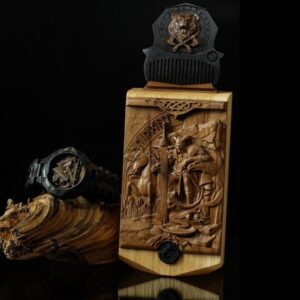
These pieces inspired our Handcrafted Raven Pendant made in genuine sterling silver.
Huginn and Muninn

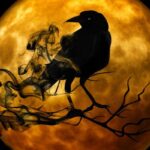
These bird of prey ornaments are often associated with Huginn and Muninn, the two companion ravens of Odin, whose names mean “thought” and “memory.” The sources say that they would fly out into the world every day at dawn to act as the eyes and ears of the god, returning at dusk to tell him everything they had seen.
According to the Heimskringla, Odin gave the ravens the ability to speak so that they could report back to him. The Third Grammatical Treatise says that Odin was often called Hrafnagud, the raven god, and that they would sit on his shoulders.
It seems very likely that the ravens were part of Odin, part of his complex Norse soul, as the Poetic Edda tells us that the god always fears that the birds will not return to his side.
As a symbol of Odin, the principal Norse god and the Viking god of war, the Norsemen adopted the raven as their symbol. Ragnar Lodbrok is said to have fought under a banner embossed with a raven, and if it flapped in the wind, it was a sure sign that he would win. On this basis, it has been suggested that these ravens were symbols of Odin.
Hraesvelgr

However, if we bear in mind that this particular bird is actually an eagle, it opens up the possibility that it could be a reference to Hraesvelgr, the eagle that was said to live at the top of the world tree Yggdrasil. His name means “corpse swallower,” and he is the source of the wind. Because so little information survives about this eagle, it is hard to interpret what it may have meant.
Eagles appear elsewhere in Norse mythology. For example, Odin turned himself into an eagle when he needed to fly away and escape after stealing the Mead of Poetry. So, there are other possibilities.
Fuglefibel

Fuglefibel, or bird fibulae, do actually depict ravens. Hundreds of examples survive, but among the best is a brooch from Uppakra. It shows the bird from a bird’s eye view, from beak to tail, with its wings at its side. In many examples, including this one, you can see the head of a man on the back of the bird.

This has inspired our Handcrafted Raven Pendant, though our artisans have added a modern twist to the design. It is handcrafted in sterling silver with a black spinel feature.
Female Status

It is usually assumed that the man looking out from the back of the raven is Odin, since he is the raven god, but other possibilities have been suggested.
It has been pointed out that these raven ornaments are most often found in the context of female graves, suggesting that they were related to female power rather than warriors. Also, most of the examples that survive have been burned as part of the burial process, dulling their shine. They would have been shining status symbols in their day.
This female association suggests a potential link with the goddess Freyja. It has been pointed out that in one story, Loki borrowed Freyja’s falcon cloak to fly, and that it may be Loki looking out from the back of the bird.
While not necessarily linked to this specific story, an association with Freyja still makes sense. She was the goddess of Seidr magic and the patron of seers. It was believed that one of the abilities of the Volva was to take the form of an animal, not in the physical world, but in the spiritual world, allowing them to see over great distances and look into the future. It is possible that this is what the raven represents. This would also explain why the symbol was associated with women, since this was considered a female art.