If you browse the VKNG shop over the coming months, you will see that we are increasingly offering our designs in bronze, alongside our long-established gold and silver offerings. These are designed to be more affordable options, while still representing quality and authenticity.
Authenticity? Bronze was used extensively in the Viking world for the same reason. It was the metal of the “everyday Viking.” It was usually only the wealthy who could afford gold and silver. We hear more about artifacts made in gold and silver because they tend to be more spectacular, not least because they better retain their sheen over the centuries. Bronze buried in the ground for 1,000 years can often appear black. This is due to black patina, which is an external layer of corrosion.
Let’s take a closer look at bronze in the Viking world, how it was produced, what kinds of objects were made in bronze, and how they have inspired our collection.
Metallurgy: Copper to Bronze

While gold and silver were prized metals in the Viking world, copper was significantly more plentiful and also had a distinctive sheen. From the Bronze Age (1700-500 BCE in the Nordic world), craftsmen mixed copper with other alloys to make it harder and more durable against the elements. It was most often combined with 5-10% tin to produce bronze. However, in the Viking world, we see a wide range of copper alloys. They also combined copper with zinc to make brass, and also lead and iron.
Archaeology suggests that metallurgy, from precious metals to steel, was often done in the same workshops. When it came to bronze, copper was extracted and then smelted in a furnace with sand and charcoal to remove the waste material. The copper had to be heated to 1100 degrees Celsius by pumping with bellows for the copper to flow out the bottom and then be shaped into ingots for storage.
The use of bellows is reflected in the story of the making of Thor’s Hammer. When Loki went to the dwarves to commission their work, and then promptly sabotaged it, he did this by turning himself into a fly and trying to distract the dwarf working the bellows.
Making in Bronze

Bronze and other copper alloys were fashioned in several different ways. One method was using moulds, which could be made in a variety of different ways. Often, designs were carved in wood, wax, or some other malleable material and then covered in clay that was baked to harden. If the model was made from wax, the wax was often heated to remove it and make room for the bronze. Any residual wax left in the mould was melted by the newly introduced molten copper, to which an alloy metal was added at this stage.
Sometimes, iron objects were gilded in bronze. Bronze foil was added to objects, which were then covered in clay and heated, leaving behind a shining bronze sheen on the surface. We also see embossed bronze plates printed using bronze dies, and bronze wire used as decoration.
The most famous examples of surviving bronze dies are the four Torslunda plates found on the island of Oland in Sweden. They date from the Vendel period, right at the start of the Viking age, dating to between the 6th and 8th centuries CE. These plates were designed for production, and thin sheets of metal foil were placed against their design, and pressure was applied to emboss the design.

These plates are famous as they may represent the process of Berserker warriors communing with the spirits of wild animals to take on their energy in battle. In particular, a man dancing with a horned headdress alongside a man wearing a wolfskin might represent the ritual practices involved. A man standing between two bears may be suggestive of the moment of transformation.
Several bronze helmets with this kind of decoration survive from Valsgarde in Sweden, about three kilometres north of Old Uppsala. There, almost 100 graves have been found dating from the 4th century BCE to the 11th century CE. The Viking age graves include a few fine boat burials that likely belonged to princes or important warriors. Several of these graves contain bronze helmets. The example above is from grave 5, which dates to the 7th century CE. It features a nosepiece with the characteristics of a raven, seemingly a reference to Odin’s familiar birds.
Bronze Artifacts

Helmets were not the only objects that the Vikings made in bronze. While most weapons were made in steel, decorative sword pommels were often made in bronze, and hilts were embellished with bronze. There are even several surviving examples of bronze axes, though these were probably decorative rather than wielded on the battlefield.
One of the most common items made from bronze were brooches, pins, buckles, and other objects that were used to secure clothing in place.
More prestige jewellery items were also made in bronze, including armrings. These were often gifted by chiefs to their warriors as a sign of the loyalty and obligation that existed between the two. While chiefs would give their most important warriors gold or silver rings, lower-level Viking warriors sometimes received bronze rings.
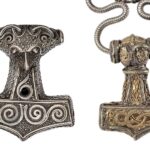
Pendants of Mjolnir, Thor’s Hammer, were also very popular in the Viking age, with many examples surviving into the modern day. It is assumed that they were worn as symbols of protection, and mythology says that Thor was the strongest of the Aesir gods and was responsible for protecting both Asgard (the realm of the gods) and Midgard (the realm of men) from the threat of the giants. An example of a bronze Mjolnir survives from Hebedy.

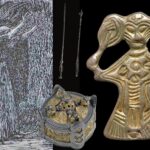
Bronze was even considered sufficiently fine for images of the gods, though again, those who could afford it preferred gold or silver. Perhaps the best example is a small seated figure in bronze dating to around 1000 CE and found at Eyrarland in Iceland. It is assumed to represent the god Thor, as his beard extends down where he grabs it with both hands, and blow that it forms a hammer shape, familiar from Mjolnir pendants. It is unclear whether this was a devotional object, or perhaps a game piece.
Another example was found at Rallinge in Sweden and is a small bronze figure from the Viking age with a noticeably erect penis. For this reason, it is assumed to be the god Freyr, who was described as having phallic statues.
Bronze in the VKNG Collection
As mentioned, we have started making more bronze pieces for the VKNG collection, as it allows us to combine authentic Viking style and design with affordability. You will find the latest pieces available in our Brass of the North Collection.
Here are my five favorite pieces from the new collection.

This handcrafted pendant shows one of the ravens of Odin flying over the crescent moon with blue gem detail for additional sparkle.
Odin’s ravens represent the All-Father as the god of wisdom and his power to see and understand all. It links nicely with the moon, long associated with divination and foresight.
This stylized bronze Vegvisir pendant features the Norse Compass, a genuine runic stave from the Icelandic grimoires.
According to the magical texts, this is a wayfinding symbol. Use it, and you will never lose your way, even if you do not know where you are going. It offers spiritual guidance.


Armrings were one of the most important pieces of jewelry for a Norse warrior as it was a symbol of the mutual respect between chief and warrior.
This serpent head armring represents Jormungandr, the dangerous beast that encircles the realm of men and will only break its hold at Ragnarok.
The runes were a powerful magical tool in the Viking world, wielded by warrior rune masters.
Odin hung himself from Yggdrasil, the world tree, for nine days and nights to discover the secrets of the runes, symbolized by these Elder Futhark runes etched on bronze bark.


This bronze dagger pendant with cubic Zirconia is etched with the runic inscription “Valhalla.”
Odin’s afterlife in Asgard, only the bravest fallen warriors found themselves in Valhalla. The dagger represents the courage and bravery required in life to earn a place in Valhalla after death.
You will also find other bronze pieces across the rest of the collection, such as…
Bronze Mjolnir Pendants

We have a range of Mjolnir pendants made in bronze available in the collection, many based on genuine Thor’s Hammer pendants surviving from the Viking Age.
The first example above is a raw pendant reminiscent of those worn by less wealthy men in the Viking Age.
The second is inspired by a 9th or 10th-century amulet found in Denmark in 2014, which bears an inscription explicitly indicating that it is a hammer, confirming what archaeologists had already believed for centuries.
The third is inspired by a 10th-century Mjolnir found at Odeshog in Sweden. It is famous for its detailed design. The handle looks like a warrior in a helmet or the face of a raven, which is a common design feature.
Bronze Viking Arm Rings

Armrings were some of the most common pieces of jewellery worn in the Viking age as symbols of status and loyalty to a group. They were mostly made in silver, but bronze examples also survive.
Above, the middle design is based on a genuine archaeological find from Viking Orkney. The triangle design may be meant to allude to the Valknut.
The first armring is a modern twist as it has a stylish cuff design, but with Viking patterns to maintain a link to the past.
The final armring is another cuff design which, while not based on a find, pays homage to Viking art, which often used animals with elongated bodies as a central theme.
Bronze Norse Symbol Pendants

Many items in our bronze pendant collection use genuine Norse symbols found on artifacts from the Viking age.
The first example shows Vegvisir, also known as the Norse Compass. According to early modern Icelandic grimoires, if you use the symbol, you will never lose your way, even if you don’t know where you are going.
The second example shows the Valknut, which was probably the symbol of Valhalla, because it always appears in connection with Odin or death. Rather than being grim, this is aspirational: live well and win your place in Valhalla alongside the gods.
The third example is a classic Viking round shield decorated with an ouroboros, a snake that circles itself and holds its own tail in its mouth. This is clearly Jormungandr, a deadly enemy of the gods who was thrown into the water surrounding Midgard. There, he grew to such an enormous size that he can encircle the whole world and hold his tail in his mouth. He will only drop his tail and emerge to fight in the final battle of Ragnarok.
Bronze Images of the Gods

Finally, just as the Vikings sometimes used bronze for images of their gods, so do we!
The first example below is a replica of the bronze figure of Thor from Eyrarland, Iceland, mentioned above.
The second example is a bronze version of a golden gullgubber used to sanctify buildings to the gods found in Denmark. It is believed to show the god Freyr and the giantess Gerdr in their sacred marriage.
Finally, we have our own design of the Odin statuette, showing the god in his guise as a wanderer, seated on his throne in Asgard, looking out over the cosmos. He is accompanied by his two ravens, Huginn and Muninn, and his two wolves, Geri and Freki.