Many people are familiar with the Oseberg ship burial, as it is one of the most famous and well-preserved ship burials surviving from the Viking age. It is known for its elaborately decorated ship, unusual Buddha bucket, and the two enigmatic women buried inside. Fewer people know that it is one of our few sources of textiles from the Viking age, and that it contains a fragmented tapestry that preserves a very interesting procession scene.
Discovery of the Oseberg Ship

In August 1903, farmer Knut Rom found something interesting when he dug into a large mound on his property near Tonsberg in Vestfold, Norway. He immediately called on Professor Gabriel Gustafson from the University of Oslo to verify that he had found something special: a Viking ship burial. Gustafson and his team returned the following summer for the official excavation.
What they found was a Karve clinker ship made almost entirely of oak that measures 21.58 meters long and 5.10 meters wide. The tightly packed clay, soil, and peat meant that the wood and other organic material were extremely well preserved. However, a hole was cut into the bow of the ship, probably by medieval grave robbers, which caused the ship to break into thousands of pieces that had to be painstakingly reassembled.
The excavation took just three months to complete, and restoration work took 21 years.
Inside the Ship

The elaborately decorated ship seems to have been built around 820, though with older elements, and buried in 834. This suggests that it was once used for seafaring – Karves were used as both warships and transport ships – and later repurposed as a final resting place.
Inside were the bodies of two women, both lying in the same bed. There was an older woman, around 80 years old when she died and suffering from bad arthritis. She also had Morgagni’s syndrome, which would have given he a masculine appearance, potentially even a beard.
The second woman was possibly 50-55 years old. A broken collarbone was previously taken as evidence that she was a human sacrifice who accompanied her older companion, but evidence of several weeks’ worth of healing suggests that this may have been a more mundane accident.
No artifacts of previous metal were found in the boat, probably due to those vandalizing grave robbers, but the size of the boat, the variety of other funerary artifacts, and the fine dresses of the two suggest that at least one of them was a very important individual.
Based on the date and location, it has been suggested that the older woman was Queen Asa of the Yngling clan, the mother of Halfdan the Black and grandmother of Harald Fairhair. Others suggest that she was a respected Volva or shaman. These theories do not take into account the strong masculine attributes of the older woman, which may have been the reason for her exceptional position. We will probably never know who either of these women was.
Oseberg Textiles

While it may contain no gold or silver, the Oseberg ship burial contains a myriad of interesting artifacts. These include four elaborately designed slights, a richly carved four-wheel cart, and the skeletal remains of 14 horses, an ox, and three dogs. But for many Viking scholars, the most interesting artifacts are the fragmentary textiles. Textiles generally preserve so poorly that these are some of the very few surviving examples.
In terms of clothing, one woman (it is unclear which) wore a very fine red wool dress with a white linen veil and an under tunic with small silk appliques. The other woman wore a plainer blue dress with a wool veil.
There were also other textiles, including a rolled-up rug, curtains, and fragments of a tapestry that was placed in the burial chamber.
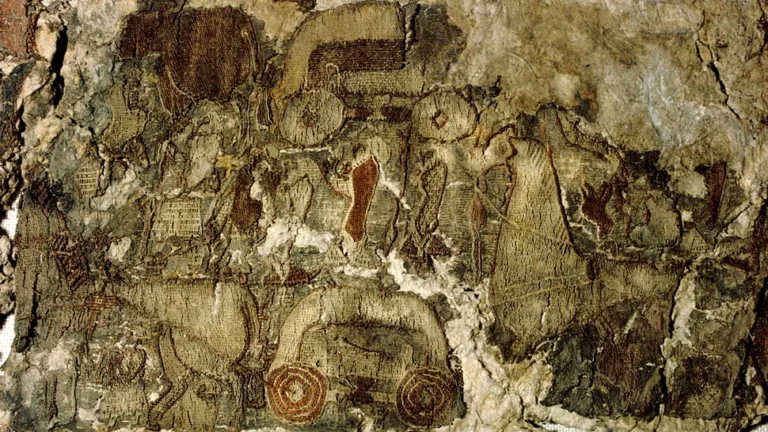
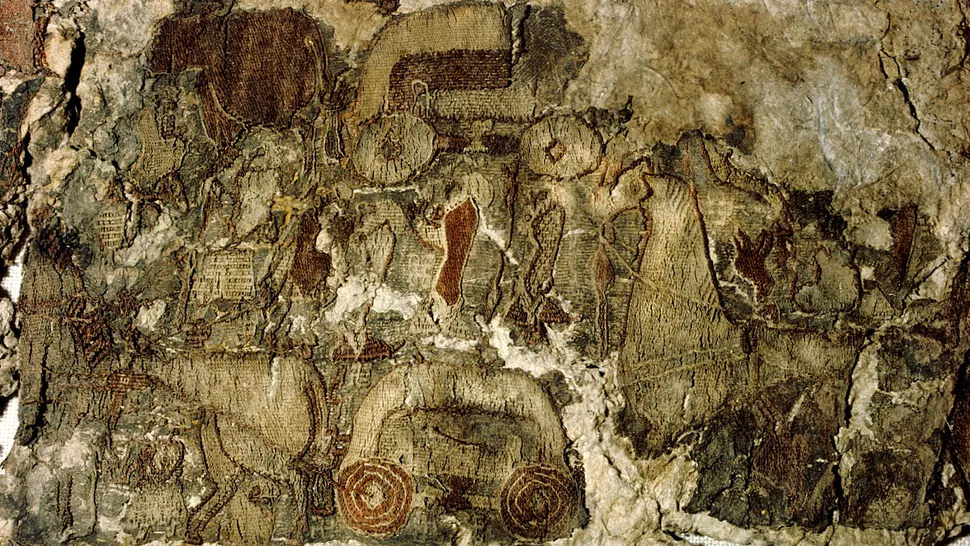
The tapestry fragments are now faded but were once brightly colored. Around 80 fragments have been reconstructed into a piece 16 by 23 centimeters, but it is unclear how large the original tapestry was. It depicts part of a processional scene with many interesting details.
The Oseberg Tapestry

The tapestry includes a variety of finely designed figures, including humans, animals, ships, and carriages. They seem to tell the narrative of a procession, possibly a funerary procession, that led towards a great tree, potentially meant to represent the world tree Yggdrasil. Perhaps Yggdrasil represented the passage to the afterlife, as the deceased would leave Midgard to one of the other worlds.
The central element in the scene is two covered carriages drawn by large horses, which could potentially be the funerary carriages of the two women. These could even be some of the very carriages and horses that were later interred as part of the Oseberg burial. A four-wheel cart also goes in front of the carriages and represents another artifact found in the burial.
Also going before the carriages is a large figure on horseback, who seems to be accompanied by two ravens. This must be Odin, who was often accompanied by the two ravens Huginn and Muninn. There are both male and female figures, wearing armor and carrying weapons, walking between the carriages. The spear was a weapon associated with Odin, and this could suggest that they were warriors who dwelled with Odin in Valhalla, potentially escorting the recently dead to their new home.

Three female figures who stand near the tree could be the Norns, the Norse fates, who were known to live at the base of Yggdrasil and decide the moment when every person is destined to die. They look much like precious metal figurines of women from the Viking Age, suggesting that they were present at the moment of death. Or they could be Valkyries, who helped take fallen warriors to Valhalla.
Several men are also hanging from the tree. This seems to be a reference to Odin’s sacrifice. He hung himself from Yggdrasil for nine days and nine nights while pierced by his spear to learn the secrets of the runes. This was later a form of execution occasionally practiced in honor of the god.
Unfortunately, without further context, these interpretations are speculative.
The Overhogdal Tapestries

The only real point of comparison for the Oseberg tapestry is the Overhogdal tapestries found in Sweden that date to 1040-1170. Much better preserved but with a less clear context, they also show processional scenes, but seem to point to mythology rather than a real-life event.
Like the Oseberg tapestry, trees, presumed to represent Yggdrasil, are a feature of the tapestry. This suggests that it is an important motif, even though it is not seen in many other contexts.
While there is a lot happening in these tapestries, two scenes have gained the most attention. The first shows a room with several people standing inside with what seems like poles projecting up from the roof and a crude runic inscription below that reads “gudby”. Next to this is a hexagonal room with a figure lying on the floor. It is surrounded by what appears to be bindings or serpents.
The second part of this imagery has been interpreted as Loki, bound by the entrails of his own son, and with a venomous snake hanging over his head. He has been placed here for his role in the death of Balder. He will only escape this prison at Ragnarok, when he will lead the war against the gods.
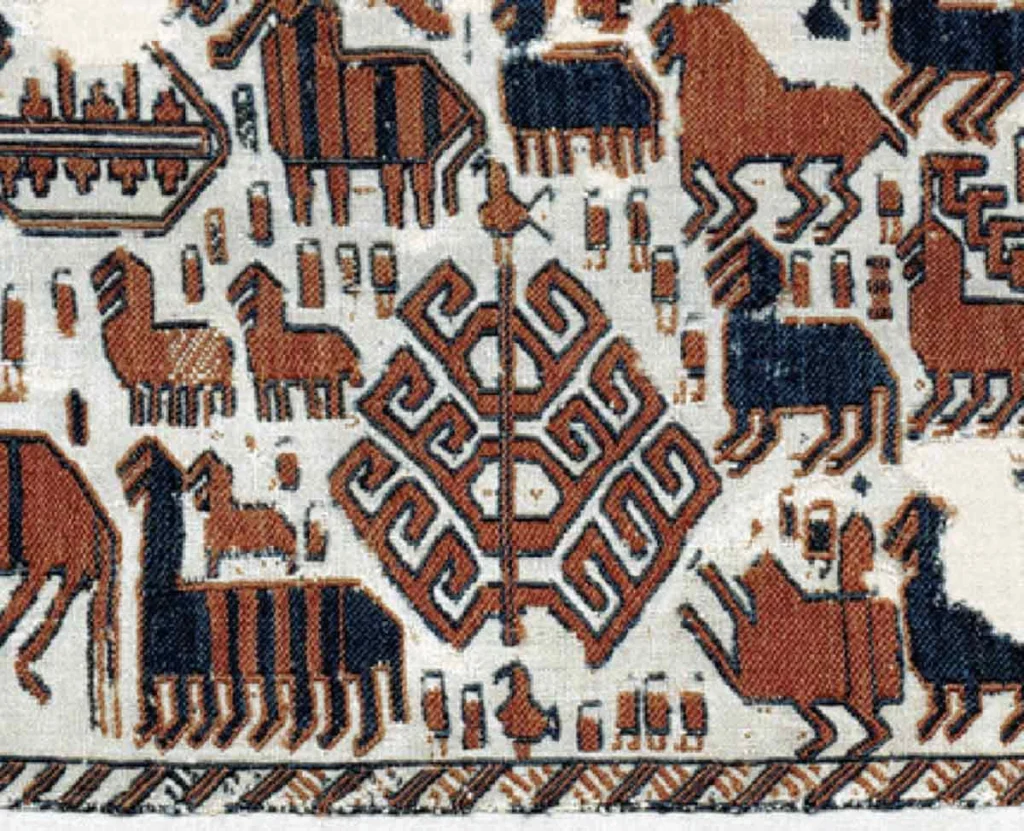
The runic inscription under the neighboring image probably means “dwelling of the gods”, so this must be Asgard. Perhaps this is the gods inside one of their halls deciding what to do about Loki.
The second section is close to the tree design at the center of the tapestry. What appears to be a bird of prey sits atop the tree and is surely meant to be the eagle that lives at the top of Yggdrasil. Several stags are also close to the tree, and according to Norse mythology, four stags lived in the tree.
Underneath the tree, there is an eight-legged figure. This is clearly Sleipnir, the eight-legged horse of Odin. He was one of the few beings that could move between the different realms of the cosmos, and in particular, pass to the lower realms.
Sleipnir is followed by a procession of figures approaching a rectangular object. This has been interpreted as Odinand his entourage descending to the Well of Mimir when he receives news of Ragnarokto receive Mimir’s counsel.
Above the tree, there is a beast with visibly wide-open jaws. This has been interpreted as Fenrir, the mighty wolf destined to devour Odin at Ragnarok.
Viking Tapestries

That tapestries were important in the Viking age is expressed in the Lay of Gudrun, which describes how tales and stories were expressed through embroideries and tapestries. Gudrun Gjukesdatter travels to Denmark in mourning after the death of Sigurd Favnesbane, where she weaves her story into tapestries.
On the tapestry wove we warrior’s deeds.
An the hero’s thanes on our handiwork;
(flashing shield and fighters armed.
Sword-throng, helm-throng, the host of the king).
Sigmund’s ship by the land was sailing,
Golden the figure-head, gay the beaks;
On board we wove the warriors faring,
Sigar and Siggeir, south of Fjon.
(Lay of Gudrun, 2.15-16)
Yggdrasil in the VKNG Collection
These tapestries highlight the importance of Yggdrasil as a symbol in the Viking world. It is part of the fabric of the universe and seems to be connected with the transition between life and death. With that in mind, check out some of the stunning Yggdrasil-inspired pieces in the VKNG collection.
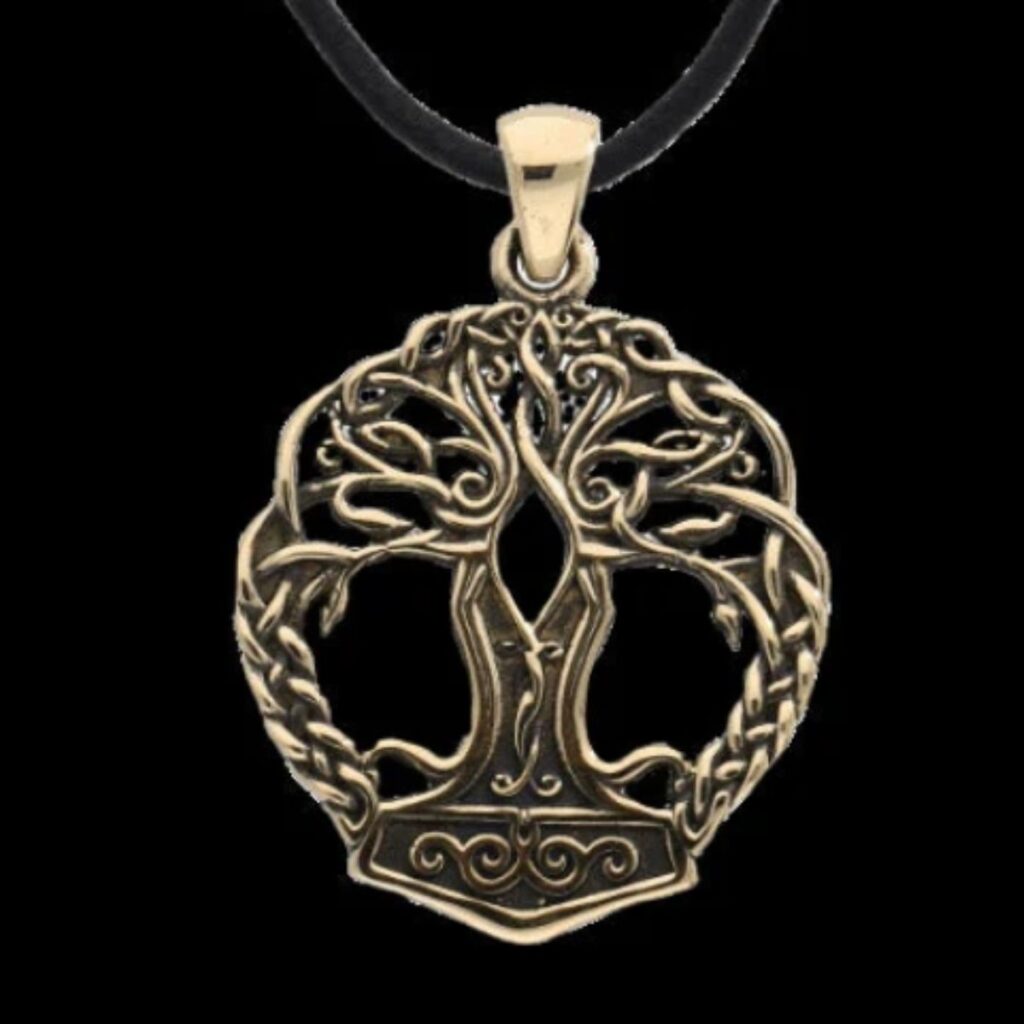
This bronze pendant combined Yggdrasil with a classic Thor’s hammer pendant, a popular symbol of protection in the Viking age, combining two potent symbols.
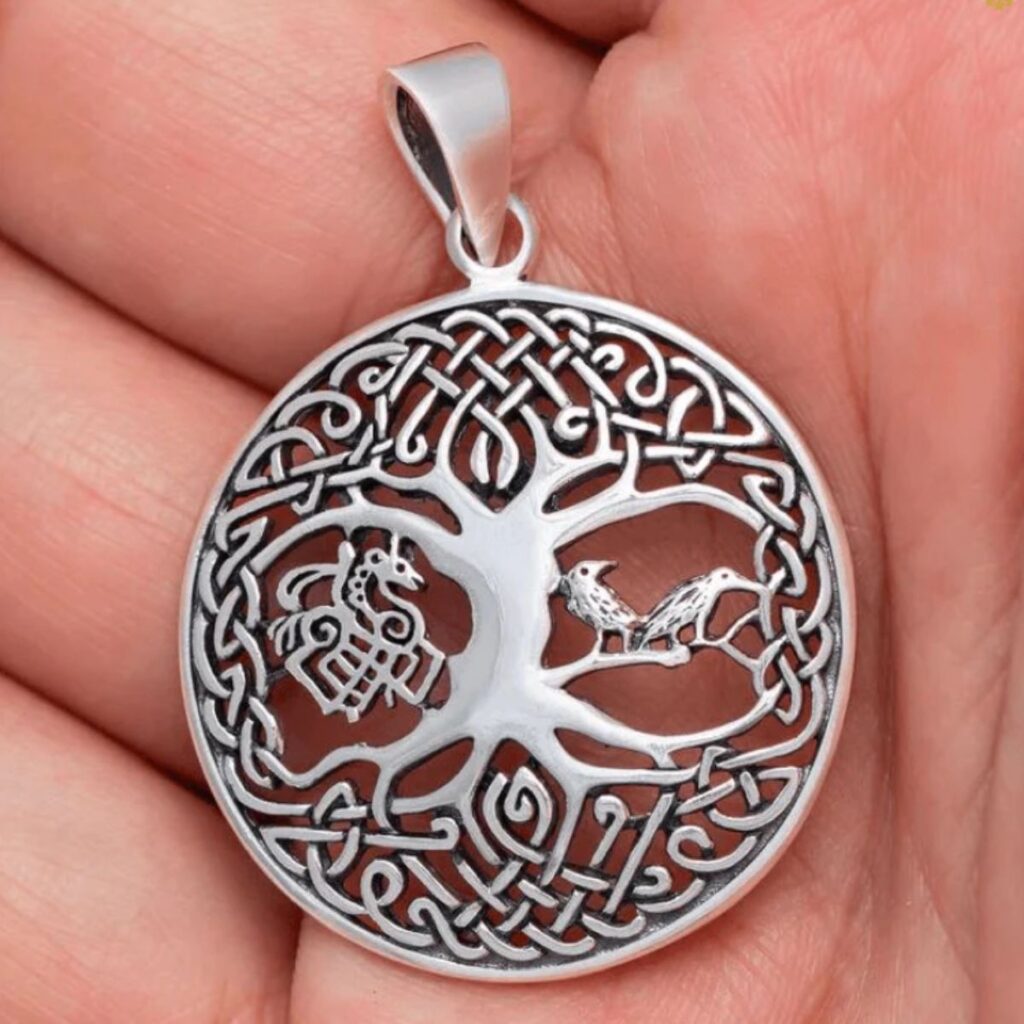
This sterling silver Yggdrasil pendant explores similar themes to the Viking tapestries, with Odin’s ravens and steed Sleipnir among the branches of the mighty world tree.
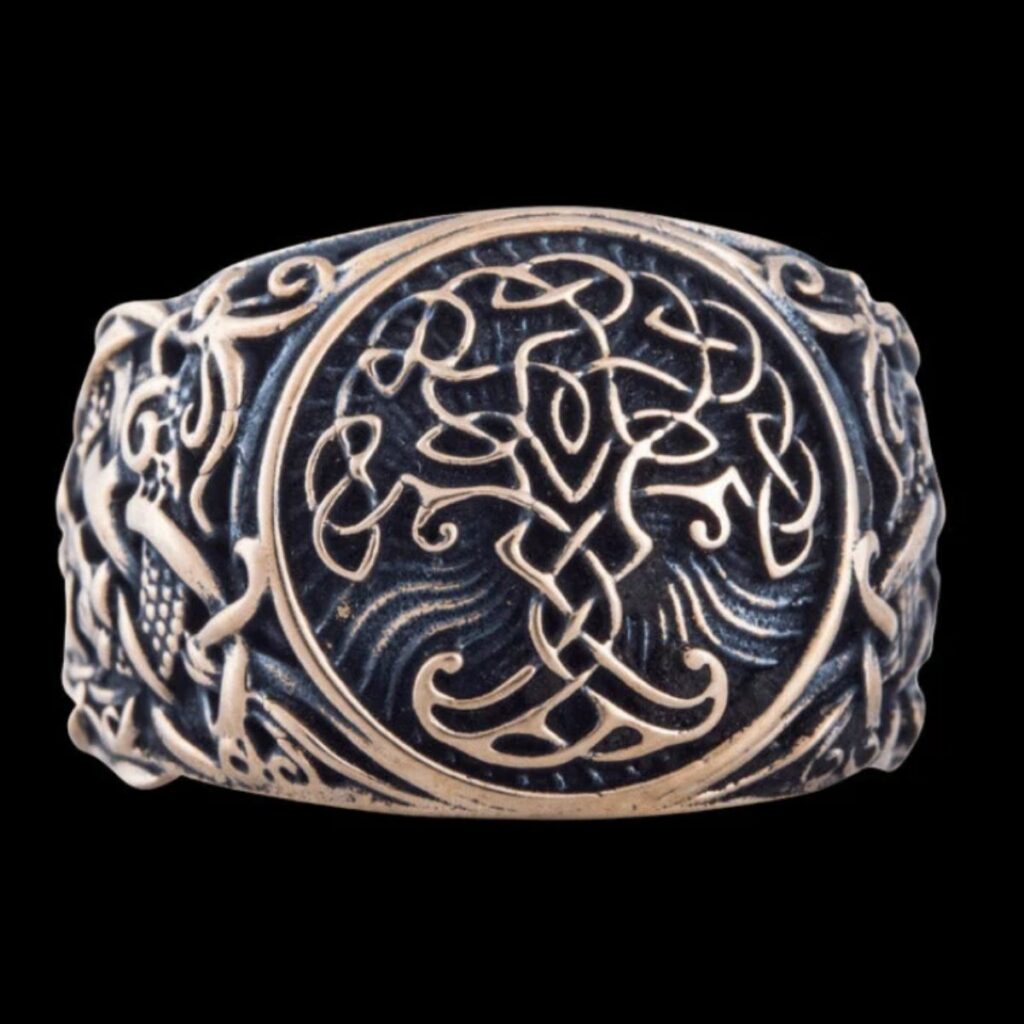
This bronze signet ring is the ideal way to adopt Yggdrasil as your symbol, celebrating the interconnectedness of all things and the power in understanding and recognizing those connections.
Famously, Odin saw the Norns writing fate into the bark of Yggdrasil with the runes. He hung himself from the tree for nine days and nights to learn the secrets of the runes. This is why Yggdrasil and the runes are intimately interconnected.
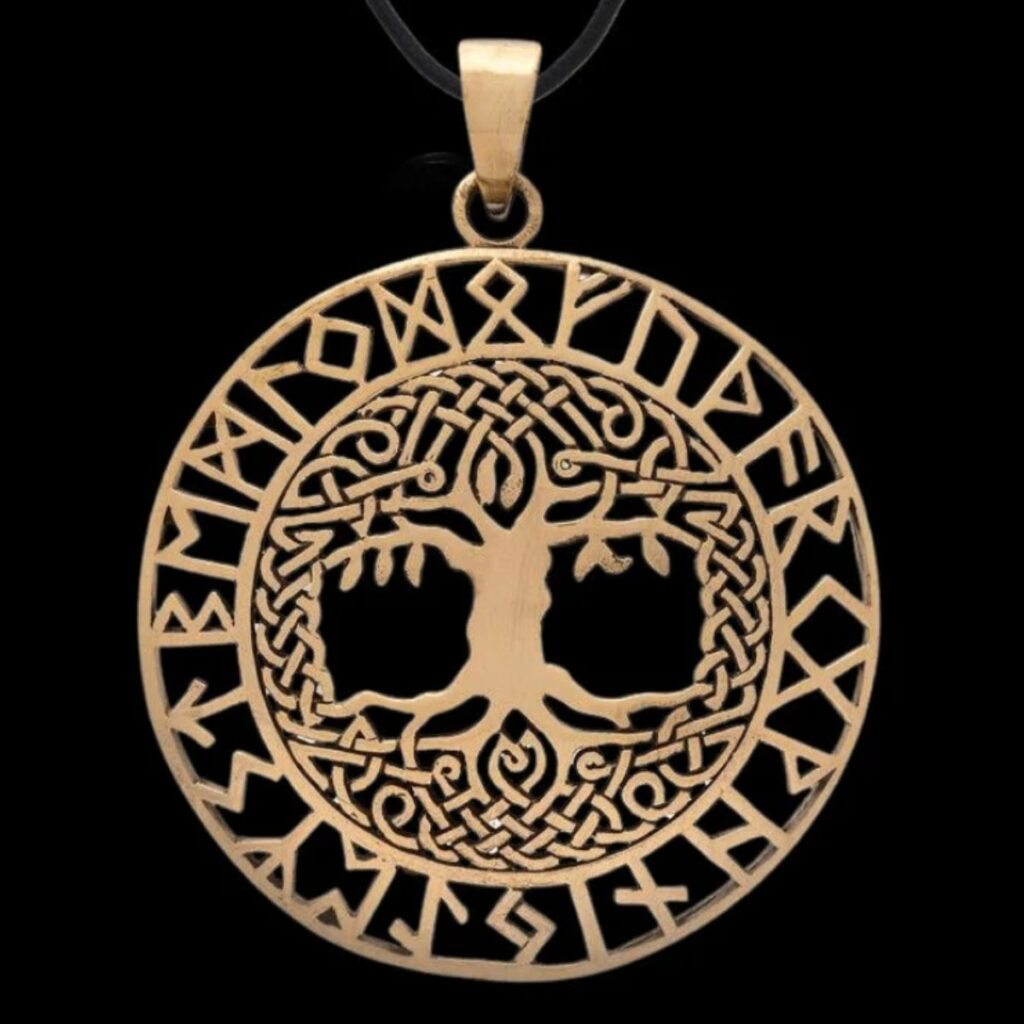

This bronze, antique-looking pendant expresses the power and beauty of Yggdrasil with a simple but compelling design.