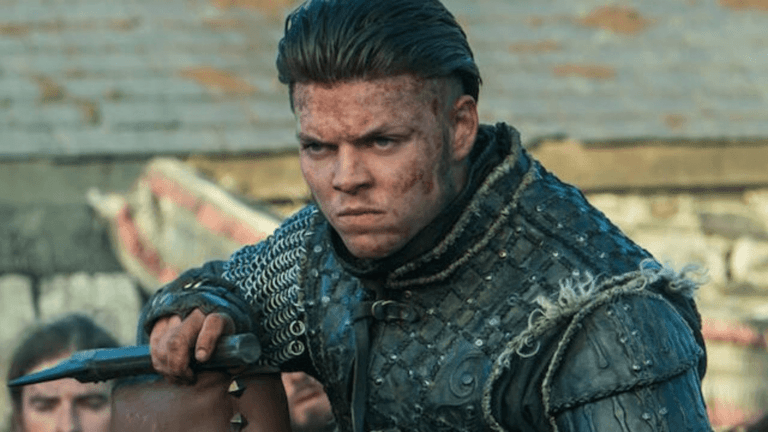
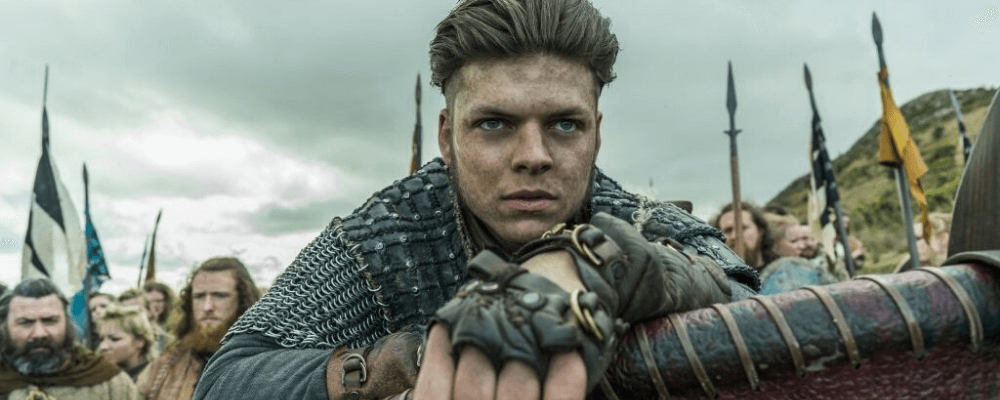
Anyone who has seen the History Channel’s Vikings will be familiar with Ivar the Boneless (Ivar hinn Beinlausi), the brutal but crippled youngest son of Ragnar Lodbrok. A cunning and ruthless tactician, he leads his brothers on an invasion of England to avenge the death of his father.
That Ivar was one of the leaders of the Great Heathen Army tracks with what we know about the real Ivar Ragnarsson, but that is where the similarities between the character and the legend end.
How likely is the story of a crippled Viking war leader? Find out as we separate fact from fiction with the story of the real Ivar the Boneless.
Was Ivar the Boneless a Real Viking Warrior?
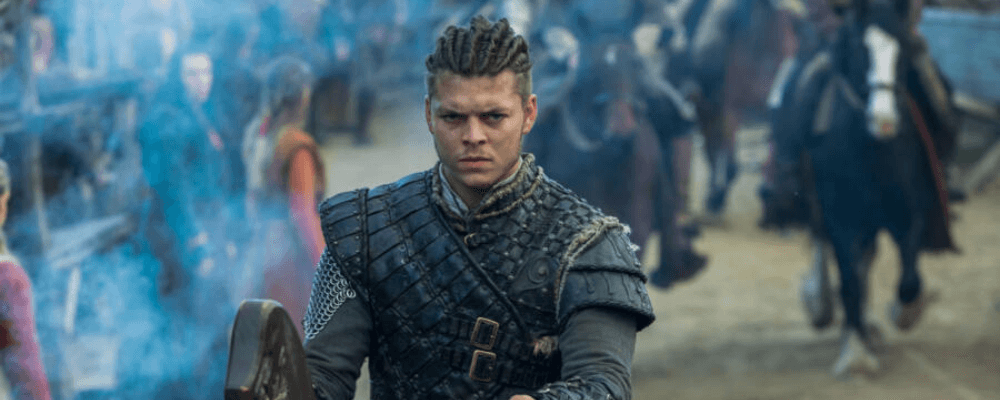
Ivar Ragnarsson was almost certainly a real Viking warrior. He appears in the sagas, and there are references to him in some contemporary sources from the late 9th century.
However, since the sagas are mostly legendary and were written centuries after the events they record, they include fantastical elements such as dragon-slaying; it is hard to determine how accurate they are.
Also, it is not always certain that the “Ivar” mentioned in other contemporary sources is the same Ivar who features in the sagas.
Nevertheless, Ivar, known as Ivar the Boneless, was probably one of the sons of the legendary Danish king Ragnar Lodbrok.
Ivar Was One of Ragnar’s Most Important Sons
Ragnar had many sons. The eldest were with his wife Thora, the daughter of the Jarl of Gotland, Eirik and Agnar.
After Thora died, Ragnar encountered Aslaug while he was raiding the Norwegian coast. According to her legend, she was the daughter of Sigurd, the famous dragon slayer, and Brynhild, the Valkyrie.
However, her parents died shortly after her death, and she was adopted by a poor Norwegian family that kept her parentage secret and renamed her Kraka. Despite her ostensibly humble origins, Ragnar fell deeply in love with her. Conveniently, her secret past was then revealed, making her an appropriate consort for a king.
They had several sons together: Ivar, Bjorn Ironside, Halfdan Hvitserk, Rognvald, and Sigurd Snake-in-the-Eye.
Ragnar also had another son, Fridleif, by the shieldmaiden Lagertha, but he lived with his mother rather than at Ragnar’s court. He also had a son Ubbe with an unknown woman.
Was Ivar Crippled?
According to the sagas, Aslaug had a vision that if she and Ragnar did not wait three days to consummate their marriage, any child conceived during these three days would be born boneless. But it seems that Ragnar was unable to control his lust, and thus Ivar the Boneless was born. But what exactly does it mean to be boneless?
In the television series, Ivar is depicted as crippled from the waist down. This appears to agree with some legends. In one story, Ivar is described as being carried on a shield and as having incredibly upper body strength, something that someone who needs to use their arms to move might develop.
But the reality is that if Ivar was born crippled, he is highly unlikely to have survived into adulthood. In many cultures, including Viking culture, it was common practice to expose babies that were born crippled or deformed, leaving them in the wild to die. In some cultures, it was even common to expose female babies, as families simply didn’t have the resources to care for them.
This was not cruelty. Child mortality rates were high, so people had to adopt a different attitude toward children to deal with the high number of infants who died. Without reliable birth control, pregnancy could be unpredictable and unwelcome. Parents had to consider the resources needed for the whole family and what another mouth to feed might mean for everyone.
In the case of disabled children, it was generally considered a mercy, as it was unlikely that they could survive the challenging life of a Viking.
So, the fact is, if Ivar was born with a crippling disability, he probably would not have made it into adulthood, one way or another, so the nickname probably refers to something else.
Some scholars have suggested that he was impotent, as he is also described as having no love or lust and as dying childless. He may also have had very little interest in women, as he never seems to have married. His wife Freydis in the series Vikings is entirely fictional.
Others have suggested that he was born with hyper-flexibility, like a contortionist, which may have made it seem like he didn’t have bones.
Yet others have suggested that his name is a reference to his cruelty and that he was actually called Ivar the Cruel, Ivar Exosus, in Latin. A medieval scribe could easily have misinterpreted this as Ivar without (ex) bone (os).
The fact that he is sometimes described as being carried on a shield should not be given too much weight. Successful Viking warrior leaders were often carried on the shields of their defeated enemies, and it seems that Ivar was a successful leader.
Ivar Was a Clever Tactician
The sources are consistent in their description of Ivar as clever and cunning. They suggest that he was the leader of his brothers by Aslaug, who spent time together as a band of warriors. He led not only because he was the oldest, but also because he was the cleverest.
One passage describes Ivar as large and handsome, but also suggests that he was so wise that it was uncertain whether there had ever been a wiser man than him.
It seems that his father also trusted him thanks to his intelligence. At some point, Ragnar made Ivar the governor of Jutland in Denmark. While he was serving in this capacity, his half-brother Ubbe hatched a plot to usurp his father.
Wanting to avoid the conflict – and probably not wanting to take sides and wait to see who came out on top – Ivar went into voluntary exile to avoid the situation. This actually earned his father’s respect, who then put him in charge of his entire kingdom as he embarked on an invasion of England.
Ivar the Warrior
Further evidence against the likelihood that Ivar was a cripple is the fact that he is often described as a ferocious warrior, particularly adept with the bow and arrow. This quality is well captured in the story of the conflict between the brothers and King Eystein of Sweden.
According to some stories, the sons of Ragnar and Aslaug decided to leave their father’s realm without his permission in order to seek their own glory as warriors. According to others, Ragnar expelled his younger sons from his kingdom, as was the practice, so that they would not conflict with the interests of his older son, in this case, his two sons by Thora. They set themselves up on Zealand, with Ivar as their leader, and made raids on the surrounding Viking territories, including Jutland, Gotland, Oland, and other minor islands.
The pressure that their presence put on the Swedish king led their older brothers, Eirik and Agnar, to go to the king and request his surrender. Instead, they were killed. The gang of brothers swiftly attacked the Swedish king to seek vengeance.
According to the story of the battle, King Eystein was accompanied by a magical cow named Sibilja that he used to wreak havoc on the battlefield. Ivar killed the cow, first striking it in the eye with an enormous arrow. This sent the cow berserk, so Ivar had himself thrown at the cow, which he then crushed with his immense strength.
There is also some suggestion that Ivar was a Berserker warrior, invoking the spirit of the bear or wolf before going into battle, making him ferocious and practically unkillable.
Ivar Led the Invasion of England with the Great Heathen Army
Ragnar may have left his son Ivar in charge in Denmark as he went off to conquer England. By this time Ragnar was a renowned warrior, and he also seems to have become arrogant, claiming that he could take England with just two ships. Instead, he was captured and killed by King Aella of Northumbria, who apparently threw him into a snake pit.
To avenge their father, Ivar and his brothers, including the infamous Ubbe, assembled a great army, known as the Great Heathen Army, which included more than 400 ships, and sailed for England in AD 865. While it cannot be confirmed that revenge for Ragnar was the true purpose of the army, the presence of an enormous Viking force in England at this time is well documented.
According to some stories, the sons of Ragnar were still hugely outnumbered when they arrived, so the master tactician Ivar refused to fight. Many of his brothers went into battle anyway, and they suffered a humiliating defeat.
Ivar, on the other hand, stayed in England and approached King Aella, presenting himself as a friend, pointing out that he alone among the brothers did not attack the king. Instead, he asked for financial compensation for the death of his father.
King Aella agreed and said that he would give Ivar as much land as he could cover with the biggest hide that he could find. What may have seemed like an insulting offer, Ivar turned into an opportunity. He cut the hide into ribbons and stretched it to an enormous size, carving out a kingdom for himself in England, with York as his capital. There, he found allies and gathered resources, eventually inviting his brothers to return and seek vengeance again, this time with a plan.
While the story of the deal with Aella is probably an invention, the Anglo-Saxon chronicle confirms that York was captured in AD 866, becoming a Viking stronghold.
With Ivar as their leader, the sons of Ragnar defeated Aella’s army and captured the king, whom they tortured to death using a technique known as the blood eagle. This involved carving an eagle into his back and then salting the wound. After this, they extracted his ribs with a sword in such a way that it also pulled out his lungs, creating bloody wings.
Ivar the Boneless in Ireland

Most of Ivar’s brothers left England following the death of Aella, returning to their own kingdoms and raiding.
According to some sources, Ivar stayed in England for the rest of his life as a local king, and eventually died there of old age. According to other sources, he left one of his brothers in England in his place and returned to Denmark, where he again died of old age. He seems to have spent at least some time in England, as there are stories of him ruling over his kingdom with a brutal fist.
Christian sources that recount Ivar’s actions make particular note of his killing of King Edmund of East Anglia. Edmund is said to have led an unsuccessful uprising against Ivar. The Viking forces that invaded England were known as the Great Heathen Army for a reason, and apparently Ivar had a particular hatred for followers of the Christian faith. He demanded that the captured Edmund denounce his faith, and when he refused, tortured him to death and left his body exposed. He then sacked a monastery, slaughtered all the monks and took their wealth.
There is also a record of a Viking Ivar as active in Ireland from 853 to 873. This would suggest that Ivar not only left England, but that he was also in Ireland at the time of his father’s death, rather than looking after things in Denmark. One of the reasons it is thought that this Ivar was the son of Ragnar is that he disappears from the sources between 864 and 870, exactly the time that he would have been in England.
According to these stories, Ivar set himself up with a kingdom in Dublin from where he raided coastal settlements, including in Scotland. This Ivar died of a sudden and horrible disease in 873.
Viking Symbols in the VKNG Collection
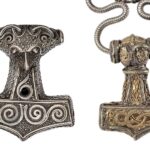
As a staunch Norse pagan, Ivar likely wore a Thor’s Hammer pendant, as it was a symbol of the protection of the gods. We also know that during the Christianization of the Norse world, Mjolnir pendants continued to be used, showing how the old beliefs continued to exist in a changing world. You can find Mjolnir pendants inspired by genuine archaeological finds in the VKNG collection.

This design is based on a 10th-century Mjolnir pendant found at Östergötland, Sweden. It features swirling loops, which were extremely common for jewelry decoration in the Viking Age.
This design is based on a Mjolnir pendant found in Scania, Sweden. The handle of the hammer looks like a raven or a warrior’s head, a common feature of many Mjolnir designs. It is probably a reference to Odin, the god of war and ravens.


This pendant is based on a Mjolnir amulet found on Bornholm Island, Denmark. The pattern of round circles was a common design on Norse jewelry, especially Mjolnir pendants.
This pendant is based on a 10th-century artifact from Iceland. It has a distinctive design with its wolf-head clasp and what seems to be a Christian cross integrated into the design. It dates to a time when Iceland was in the process of converting to Christianity, and religious lines and symbolism were being blurred.

FAQs
Was Ivar the Boneless a real historical figure?
Yes, Ivar Ragnarsson was almost certainly a real 9th-century Viking warrior who is mentioned in both Norse sagas and contemporary historical records. He is highly regarded by historians as one of the prominent sons of the legendary Danish king, Ragnar Lodbrok.
Was the real Ivar actually a disabled cripple like he is portrayed on television?
It is highly unlikely he was crippled from birth because Viking culture routinely practiced the exposure of deformed infants who could not survive their harsh lifestyle. Instead, modern scholars suggest his nickname could refer to impotence, extreme physical flexibility, or even a medieval translation error of the Latin word for “cruel.”
Why was Ivar chosen to lead his brothers if he wasn’t the only son?
Historical sources consistently describe Ivar as an incredibly clever, wise, and cunning master tactician. He earned his brothers’ and his father’s respect through his intelligence, which made him the natural choice to govern territories and lead their armies.
What is the “blood eagle” ritual that Ivar supposedly performed?
The blood eagle was a brutal torture method where a victim’s ribs were ripped out through their back to resemble bloody wings before their wounds were salted. According to the sagas, Ivar used this gruesome technique to execute King Ælla as revenge for his father’s death.
Where did Ivar go after his military successes in England?
While some sources claim he stayed in England or returned to Denmark to die of old age, Irish records suggest he actually ruled a kingdom in Dublin, Ireland, from 853 to 873. This theory is supported by the fact that the Irish “Ivar” completely disappears from local records during the exact years the Great Heathen Army was invading England.