In polytheistic religions, individual gods are often best identified by their attributes, key things they carried with them that distinguished them from the other gods in the pantheon.
In Greek mythology, Zeus has his thunderbolts, and Hermes has his winged shoes.
Norse religion is no different. Odin always carries his famous spear Gungnir and ravens overhead, is often riding his eight-legged steed Sleipnir, and is usually depicted with just one eye.
Heimdall is recognizable by his horn Gjallarhorn. Freyja wears her famous golden necklace, Brisingamen.
Thor, the Norse god of thunder, is the bearer of the most famous attribute in Norse mythology, his mighty hammer Mjolnir.
With the power to level mountains and crush the skulls of (most) giants, it causes thunder and lightning when it strikes.
But Mjolnir was only one of many attributes associated with Thor.
Read on to discover more.
Jarngreipr and Megingjord

According to the “Prose Edda,” compiled by Snorri Sturluson in the early 13th century, Thor had three key attributes: Mjolnir, Jarngreipr, and Megingjord.
Jarngreipr, meaning “iron gloves,” were a pair of iron gloves that Sturluson suggests he needed to wield Mjolnir.
However, plenty of stories exist of Thor whipping out Mjolnir without reference to the gloves, and even a few giants get their hands on the hammer, such as Thrym, and he doesn’t appear to need any gloves.
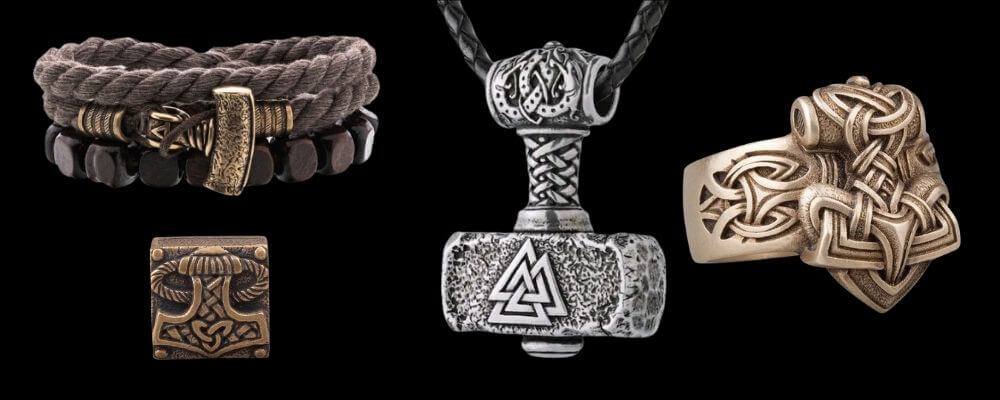
Megingjord, meaning “power belt,” serves a similar purpose, doubling Thor’s already impressive strength to wield his mighty hammer.
We do have evidence that these attributes predate Sturluson, as Megingjord is mentioned in a 10th-century skaldic poem “Thorsdrapa,” by Eilifr Godrunarson, in which he uses “he who benefits from the might belt” as a kenning for Thor.
Tanngrisnir and Tanngnjostr


In “Thor: Love and Thunder” (2022), we see Thor acquire a chariot pulled by goats, which appear a few times in stories of Norse mythology.
The goats that pull the chariot are named Tanngrisnir and Tanngnjostr, meaning “teeth barer” and “teeth grinder.”
In the “Poetic Edda,” a 12th-century collection of Old Norse poems, in the poem “Hymiskvisa,” Thor leaves the goats, described as having splendid horns, with a human named Egil in Midgard before traveling to Jotunheim with Tyr to the hall of the jotunn Hymir, where the events of Thor’s famous fishing trip take place.
When he returns to get his goats, they collapse “half-dead” due to lameness.
The poem says that this is the fault of Loki, referring to a story that the reader is already familiar with (but we are not).
Another poem called “Thrymskvida” also describes Thor driving his chariot with the goats wrenching at their halters, running swiftly, leaving a trail of fire behind them as Odin seeks Jotunheim.

In the “Gylfaginning” in Snorri Sturluson’s “Prose Edda,” a figure called High, who appears to be Odin, says that Thor has two goats that drive his chariot and gives the names of the goats.
Later, a figure called Third, also believed to be Odin, explains how Thor and Loki were riding in this chariot and stopped at the home of a peasant farmer, where they received lodgings for the night.
When they realize that there is no food, Thor slaughters his goats for meat, preserving their skins.
After they eat, he spreads the skins on the ground and lays the bones on top of them, warning the family not the damage the bones.
The son of the farmer can’t resist and breaks open one of the goat’s leg bones with a knife to eat the marrow.
The next morning, when Thor uses his hammer to resurrect the goats, one of the goats is lame due to the broken bone.
Thor flies into a rage, but accepts the service of the two children of the peasant as payment.
He then takes them to Jotunheim with him and Loki to the hall of Utgard-Loki.
Again, in the “Skaldskaparmal,” both goats are listed in a list of names of goats, when Aegir, the personification of the sea, and Bragi, the god of poetry, discuss poetry.
Lighting Eyes

In the “Thrymskvida,” which also appears in the “Poetic Edda,” we see Thor disguise himself as the goddess Freyja to pretend to marry the giant Thrym to retrieve his hammer.
The giant stole the hammer and only agreed to return it in exchange for the hand of Freyja in marriage.
When Freyja refused both the marriage and to participate in any ruse, Thor is convinced to dress up as Freyja, wearing her distinctive attribute, Brisingamen, to complete his disguise, accompanied by Loki, who shapeshifted into a handmaiden.
Thor almost gives himself away several times, especially by eating and drinking too much
. Loki runs interference, telling Thrym that Freyja was so nervous for the wedding that she had not eaten for days before, hence her appetite.
When Thrym caught a glimpse of Thor’s face under his veil, he was taken aback by his burning eyes.
Again, Loki runs interference, saying that Freya has not slept for days in anticipation, hence the eyes.
But this suggests that Thor was known for his flashing eyes, burning like lightning bolts.
Canonical Pointed Hat

While not mentioned in the sources, many Viking Age images of Thor show him wearing a canonical pointed hat.
This is most clearly seen on what is known as the Eyrarland Idol, an 11th-century Icelandic artifact, which shows him with the hat and a beard.
The sagas sometimes describe Thor as having an impressive red beard.
The meaning of this attribute is unclear, and it might just be a simplified representation of a helmet, since Thor was a warrior, and certainly the type of warrior wealthy enough to own armor.
But it was certainly associated with Thor, as he appears with the same pointed hat on the Middleton Cross, found in Yorkshire, England.
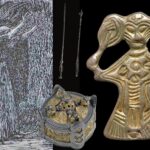
The canonical hat also appears on a statuette from Rallinge in Sweden, though the phallus suggests that this is a Freyr rather than Thor.
Though some have suggested that this is Thor, who appears to be blowing into his beard to create wind.
Jormungandr

While not really an attribute, Thor is often depicted in association with Jormungandr, the Midgard Serpent.
The two are intimately connected in Norse mythology.
They are destined to fight to the death at Ragnarok, the Norse apocalypse.
Thor will kill Jormungandr with his mighty hammer, but Jormungandr will spew so much venom onto Thor that he will also die from the encounter.
Thor was aware of his fate and considered Jormungandr his arch nemesis.
This is why, when he went on his famous fishing trip with Hymir, he was determined to catch the serpent, forcing the giant to row them further and further out to sea to where the serpent lives.
When he caught the serpent on his line, it almost unfooted him, alerting Hymir to what was happening, as only Jormungandr would have the strength to do that.
Hymir begged Thor to let the serpent go, aware that it could trigger the end of the world, but Thor ignored him.
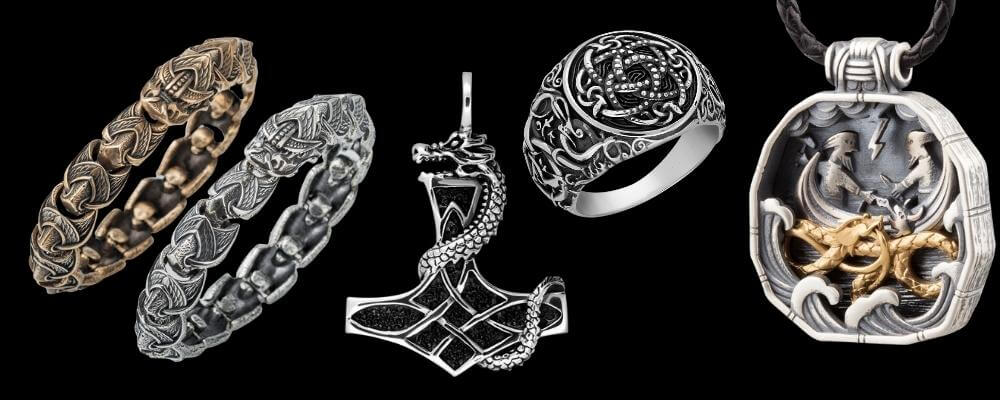
In the end, Hymir cut the line, enraging Thor.
Thor’s fishing trip is one of the most commonly depicted scenes of Thor from the Viking Age.
Undeciphered Symbols

Since the Vikings left very few written records of their own, with most of the Norse sagas surviving from versions written down after the conversion to Christianity, we don’t know much about many of the symbols that appear in the Viking Age.
Looking at later manuscripts that depict the Norse gods raises more questions than they answer.
In an Icelandic manuscript known as SAM 66, dating to the 18th century, both Thor and Odin appear with a sun symbol hanging around their neck.
This association is not seen in Viking Age depictions, and it is unclear which aspect of Norse mythology to make this connection.
Odin does sometimes appear in association with the sun cross, which looks like a swastika, the meaning of which has been corrupted by modern use.
It is believed that this represented the sun, and perhaps Odin’s supreme power, as the sun was considered the ruler of the earth.
Why the manuscript artist decided to associate the sun with Odin and Thor, and none of the other Norse gods, is unclear.