The Vikings started raiding England at the end of the 8th century and moved to invading and colonizing in the 9th and 10th centuries.
By the early 11th century, there were even Viking kings of England. But not long after that, the Norman Conquest happened, and Viking influence largely disappeared from England.
But what happened to the Vikings in England after 1066 ?
Vikings in England Before the Norman Conquest

By the early 11th century, Viking settlers occupied large parts of England.
They were settled in much of what was Northumbria, around the famous city of Viking Jorvik (York), the eastern half of Mercia, and East Anglia.
The Vikings who raided England were ideally experienced to settle.
At the time, Viking society was mostly made up of small landowners with self-sustaining farms worked by extended family members and slaves.
This is what gave Viking men the wealth and freedom to leave their homes for several months each year and equip themselves with arms and ships to raid other parts of Europe.
Therefore, the Vikings were warriors, but also farmers, prepared to take up residence and work the land.

Archaeology suggests that most of the Vikings who arrived were Norse pagans.
They brought with them stories of their gods, which inspired monuments like the 10th-century Gosford Cross.
A stone Christian cross found in Cumbria, it was decorated with images of the Norse gods, including Sigyn protecting Loki from his punishment, Heimdall blowing his horn to warn of Ragnarök, Vidar killing Fenrir at Ragnarök, and Thor failing to catch Jörmungandr on his famous fishing trip.
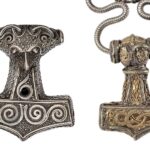
They also brought symbols like Thor’s Hammer, with many Mjolnir pendants found in the Viking areas of England.

While some Viking women also made the trip, it seems that most Vikings took English wives.
This introduced them to Anglo-Saxon ideas and integrated them into the local Christian community, eventually leading to widespread conversion.
Norse and Anglo-Saxon languages intermixed, and many Viking words are still preserved in modern English.
Despite this “assimilation” to the local way of life, the Vikings were still distinct enough that the Anglo-Saxon king could order the execution of all Vikings on English soil on St Brice’s Day in 1002 CE.
However, we don’t know exactly who he meant when he ordered “all the Danes in England” killed.
Political Intrigue

While the Vikings always had their own local leaders, it is arguable that the St Brice’s Day Massacre saw the rise of the first Viking kings of all England.
Some sources suggest that it was in revenge for this move that the Danish king Sweyn Forkbeard launched campaigns against Wessex and East Anglia in 1003-1004, 1006-1007, and 109-1012, and then a full-scale invasion in 1013.
The Anglo-Saxon King Aethelred and his two sons, Alfred and Edward, were forced to flee England for Normandy, leaving Sweyn to make himself the new king.
He died a few months later, leading to unrest, but his son Cnut the Great would eventually secure Viking power in England.
As part of the political intrigue required to secure his position, Cnut married Emma of Normandy, the widow of Aethelred and mother of Alfred and Edward.
They would have a son, Harthacnut, who would succeed his father.
But when he died childless in 1042, his mother convinced the English court to recall her son via Aethelred, Edward, as the next king.
He became known as Edward the Confessor.

Despite the relatively smooth transfer of power in England, the Vikings still considered the crown of England rightfully theirs.
King Harald Hardrada of Norway seems to have said as much and probably threatened to invade.
According to some reports, to hold him off, the childless Edward promised to bequeath the crown to Harald upon his death.
However, he seems to have made the same promise to Duke William of Normandy, who sheltered Edward and his family while they were in exile and helped them in their many attempts to reclaim England.
Nevertheless, when Edward died in 1066, rather than bequeath his crown to one of these overseas monarchs, he chose Harold Godwinson, a member of the most powerful noble family in England.
This resulted in a perfect storm, with Harald Hardrada invading from the north and William the Conqueror from the south.
Godwinson managed to defeat the Vikings, notably at the Battle of Stamford Bridge.
This weakened Godwinson’s position, and the Normans won the Battle of Hastings on October 14, 1066.
After the Norman Conquest

While the history books say very little about the Vikings in England after the Norman Conquest, they still had large communities in England after 1066.
We know that the Vikings caused issues for William while he was consolidating his power on English soil, as he reportedly had to put down three rebellions in York over the course of five years.
We also know that the Danish king Sweyn Estridson joined forces with Edgar Atheling, the last remaining heir of the Anglo-Saxon royal house, and sent a force to attack the Normans in 1069.
However, after capturing York, Sweyn accepted a payment from William to desert Edgar, who then returned to exile in Scotland. Sweyn failed another attempt against the Normans in 1074/1075.
Some Viking settlers returned to Scandinavia, and some Anglo-Saxons followed them there. But for most, the first roots they had laid down meant they stayed.
For many, life may not have seemed that different. The Normans did not bring over a large number of peasants to replace the local peasantry, which probably made up about 80% of the population.
Instead, they brought over aristocrats, who were given governance of different English regions, replacing former Anglo-Saxon and Viking leaders, who may not have been that popular.

But the new ruling class took steps to centralize governance, making it easier to raise armies and organize national defence.
The Normans also built hundreds of castles across England, from which the Norman minority could control the local population.
These structures also meant that they could better defend against Viking raids, which is one of the reasons why overseas Viking raids completely stopped by the end of the 11th century.