The National Museum of Denmark has just announced a major interdisciplinary project to further investigate its approximately 260 surviving runestones. Dating from AD 600 to 1100, they are some of the few written records left behind by the Vikings themselves, making them invaluable for understanding the Viking Age.
The project will use new technologies to see what new secrets the runestones might have to reveal, but also to understand them as a network and their meaning in relation to one another.
This is a small but significant sample of Runestones known from the Viking world. As well as the 260 in Denmark, around 2,500 runestones survive from Sweden, as well as around 50 from Norway and another 50 from the British Isles.
To celebrate this new project, let’s take a look at 20 of the most important Runestones from the Viking Age and why they are significant.
What are Runestones?

Runestones are monumental-sized stones with runic inscriptions and decoration that have been found across the Viking world. They were usually erected as memorials for the dead.
The practice was thought to have started around the 4th century AD, but a runestone recently discovered at Svingerud in Norway may push the date back as far as the 2nd century BC. The practice continued to around 1100, with the latest runestone including Christian elements. Most were colorfully painted, though the paint is no longer visible today.
1. The Rök Runestone (Ög 136)

Rök Church, Östergötland, Sweden, c. 800-825
The Rök Runestone features the longest surviving runic inscription in stone, containing around 760 Younger Futhark characters distributed across the five sides.
It was commissioned by a man named Varinn in memory of his deceased son Vámóðr. The complex text contains ciphers, riddles, early Scandinavian skaldic alliteration, and references to heroic myth, including a stanza mentioning Theodoric the Great, ruler of the Ostrogoths.
2. The Greater Jelling Stone (DR 42)

Jelling, Jutland, Denmark, c. 965
Often called “Denmark’s birth certificate,” the Jelling Runestone was raised by King Harald Bluetooth. The inscription records his unification of Denmark and Norway, his memorial to his parents, King Gorm and Queen Thyra, and his official conversion of the Danes to Christianity.
It also features the earliest surviving depiction of Jesus Christ in Scandinavia, intertwined with classic Mammen-style animal knotwork.
Alongside it is theLesser Jelling Stone (DR 41), erected by King Gorm the Old in honor of his wife, Queen Thyra. It contains the earliest native written reference to the name “Denmark” (tanmaurk).
3. Kylver Runestone (G 88)
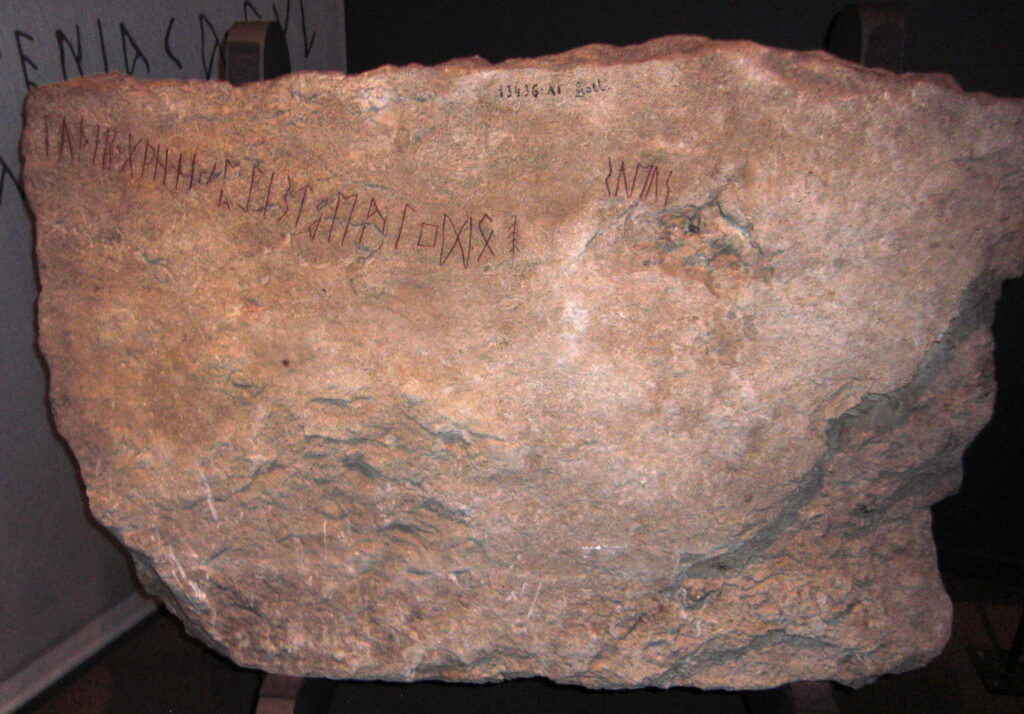
Kylver, Stånga, Gotland, Sweden, c. 400
The Kylver Stone from Sweden is one of the earliest and most famous runestones. Dated to AD 400, it lists all of the runes in the Elder Futhark alphabet, the runic alphabet used in proto-Viking times before it was replaced by Younger Futhark.
The flat limestone rock was used to seal a grave, and the runic inscription was written on the underside. This has led to suggestions that it was a spell to prevent the dead from rising.
4. Stentoften Runestone (DR 357)

Blekinge, Sweden, c. 500-700
The Stentoften Runestone also uses Elder Futhark. Dating to 500-700, it appears to contain a curse. It says that the master of the runes concealed here nine bucks, nine stallions, and runes of power to result in insidious death to whoever breaks, presumably the entrance to a nearby burial mound.
It was also found on the ground with the inscription facing downwards and surrounded by five sharp larger stones forming a pentagram.
5. The Kuli Stone (N 449)

Smøla, Møre og Romsdal, Norway (now at the NTNU University Museum, Trondheim), c. 1034
This Runestone is regarded as “Norway’s birth certificate.” It bears the earliest known appearance of the name “Norway” (Nóregr) on Norwegian soil and provides an explicit chronological benchmark for the Christianization of the region, noting that “twelve winters had Christianity been in Norway.”
6. The Gripsholm Runestone (Sö 179)

Gripsholm Castle, Södermanland, Sweden, c. 1040
This is the most celebrated of the approximately 30 “Ingvar Runestones,” raised to honor warriors who perished in the disastrous Caspian expedition led by Ingvar the Far-Travelled. The inscription concludes with a famous Old Norse alliterative poem: “They fared like men far after gold, and in the east gave eagles food; they died in the south in Serkland [the Abbasid Caliphate].”
7. The Ramsund Carving (Sö 101)

Sundby, Södermanland, Sweden, c. 1030
The Ramsund Carving is amassive 4.6-meter flat bedrock carving commissioned by a noblewoman named Sigrid. It illustrates scenes from the Völsunga saga: Sigurd slaying the dragon Fáfnir, roasting the dragon’s heart over a fire, tasting the blood to gain the ability to understand birds, the decapitated smith Regin, and Sigurd’s horse Grani laden with the dragon’s gold.
8. The Karlevi Runestone (Öl 1)

Karlevi, Öland, Sweden, c. 990-1000
Erected beside the Kalmar Strait by Danish warriors in memory of their chieftain, Sibbi. It preserves the oldest complete, unaltered stanza of skaldic court poetry written in the demanding, alliterative dróttkvætt meter ever found carved in stone.
9. The Altuna Runestone (U 1161)

Altuna Church, Uppland, Sweden, c. 1050
The Altuna Runestone is famous for its depiction of pre-Christian Norse mythology. The carving illustrates Thor’s mythological fishing expedition with the giant Hymir to snare the Midgard Serpent (Jörmungandr), complete with Thor’s foot smashing directly through the bottom of the boat to plant itself on the seabed.
10. The Ledberg Stone (Ög 181)

Ledberg Church, Östergötland, Sweden, c. 1000-1050
This four-sided standing pillar is carved with battle imagery and scenes interpreted as the events of Ragnarök. It depicts an armed warrior being devoured foot-first by a monstrous beast, widely believed to be the wolf Fenrir killing Odin, alongside a ship, fallen warriors, and a runic magical formula (“thistle, mistletoe, casket”).
11. The Glavendrup Stone (DR 209)
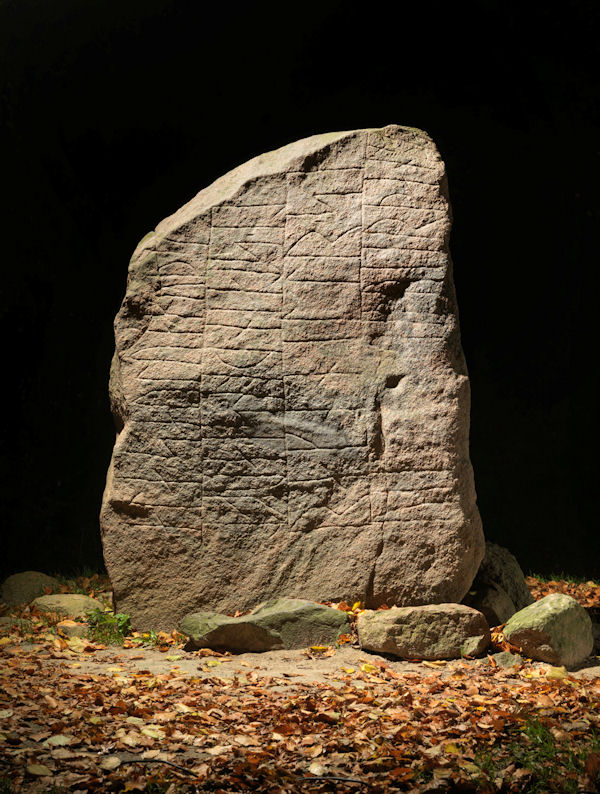
Funen, Denmark, c. 900-925
The Glavendrup Runetone contains Denmark’s longest runic inscription (210 characters). Raised by a woman named Ragnhild at the prow of an enormous, 60-meter-long stone ship setting (skibssætning) in honor of her husband Alle, a local chieftain and pagan priest (godi). The stone invokes the god Thor to hallow the monument (“Þórr vígi þessar rúnar”), as it was common to call on Thor’s Hammer Mjolnir to hallow important events.
12. The Yttergärde Runestone (U 344)

Orkesta, Uppland, Sweden, c. 1025
This runestone is a primary source for Anglo-Scandinavian military history. The stone commemorates the Viking Ulf of Borresta, recording that he collected English Danegeld three separate times under three different leaders: first under Skagul Toste, second under Thorkell the Tall, and third under King Cnut the Great.
13. The Dynna Stone (N 68)

Gran, Hadeland, Norway (now at the Museum of Cultural History, Oslo), c. 1040-1050
Carved from distinctive red sandstone, this is one of Norway’s earliest pictorial Christian monuments. Styled with dynamic Ringerike-style foliage and animal art, its panels illustrate biblical Nativity scenes: the Three Wise Men on horseback following the Star of Bethlehem.
14. The Hillersjö Stone (U 29)

Hillersjö, Uppland, Sweden, late 11th century
This is the longest runic inscription in the province of Uppland (185 runes carved directly onto a bedrock outcrop). Rather than a standard memorial, the text serves as a binding legal document tracking the complex inheritance of a major landed estate across four generations and six deaths, centered on a matriarch named Geirlaug.
15. The Sparlösa Runestone (Vg 119)

Sparlösa Church, Västergötland, Sweden, c. 800
This is an important transitional runestone as it is carved with transitional runes bridging the Elder and Younger Futhark. Alongside its enigmatic text, it preserves rare 9th-century figurative art showing multi-story timber buildings, sail-rigged warships, hunting birds, and a mounted warrior.
16. The Kälvesten Skerpinge Runestone (Ög 8)

Västra Stenby, Östergötland, Sweden, c. 820-840
This is the oldest surviving runestone to record an eastward Viking military expedition. It commemorates a brother who fell “east in Garðar [Russia]”, documenting early Scandinavian operations along the Eastern European river networks decades before the traditional founding of the Kievan Rus’.
17. Mask Stone (DR 66)

Aarhus, Denmark, c. 1030
This inscription honors the dead man relates to the Battle of Svolder, which happened around the year 1000, and the Battle of Helgean, which was around 1026.
The stone was also decorated with a fantastic black mask, giving the stone its name. It was probably meant to protect the dead against evil spirits. Similar face masks appear on other runestones throughout Scandinavia.
The stone was probably originally located along an important road into Aarhus, as were many others, but was then reused as building material.
18. Hunnestad Monument (DR 282-286)

Hunnestad, Marsvinsholm, Sweden, c. 10th century
The Hunnestad Monument is a group of runestones that were found at Hunnestad at Marsvinsholm in Sweden. It was one of the largest monuments known from the Viking Age but was unfortunately lost or destroyed in the 18th century when the region was modernized, and so only survives in drawings.
The monument originally consisted of eight runestones, five of which had images, and two of those image stones also had runic inscriptions. One of the runestones showed a large man dressed in a long coat and a pointed helm, carrying an axe on his right shoulder. His appearance suggests that he was a member of the Varangian Guard. It was erected for Hroir and Leikfrodr, the sons of Hunni Hand.
Another stone shows a Christian cross, while another shows a traditional Norse animal, probably a wolf, ridden by a woman who has two snakes in her hands. This aligns with descriptions of the giantess Hyrrokkin, who helped the Aesir push Balder’s funerary boat out to sea.
19. Thorwarld’s Cross

Church of Abdreas, Isle of Man, c. 940-1050
This runestone takes its name from the fact that the stone, which has a large cross depiction, was raised by someone called Thorwald. The runestone’s pictures show a man with a beard holding a spear downward at a wolf with his right foot in its mouth, while a large bird sits on his right shoulder. This is almost certainly Odin, identified by his spear and raven familiar, in battle with the wolf Fenrir at Ragnarök.
On the other side of the cross seems to be an image of Christ triumphing over Satan, seemingly drawing a parallel between the two stories.
20. The Kingittorsuaq Runestone (GR 1)

Discovered on Kingittorsuaq Island, Baffin Bay, Greenland (now at the National Museum of Denmark, Copenhagen), c. 1300
Found at 72°55′ N, this is the northernmost genuine Norse runic monument ever discovered. Left by three Norse hunters who carved their names, built a stone cairn, and recorded the date (late April), it proves the immense range of Arctic hunting voyages undertaken by the Greenland Norse.
Read more about (probably fake) runestones discovered in America here.
Find Your Runic Piece
As well as leaving a public record, the Vikings may have believed that runestones may have had magical properties. This is because they believed that their runes were more than an alphabet, but also a magical toolkit given to them by Odin. Therefore, they used the runes for spells and, in later times, to create complex magical runic symbols.
If you feel inspired by the Norse runes and magical symbols, check out some of our favorite runic pieces in the VKNG collection.
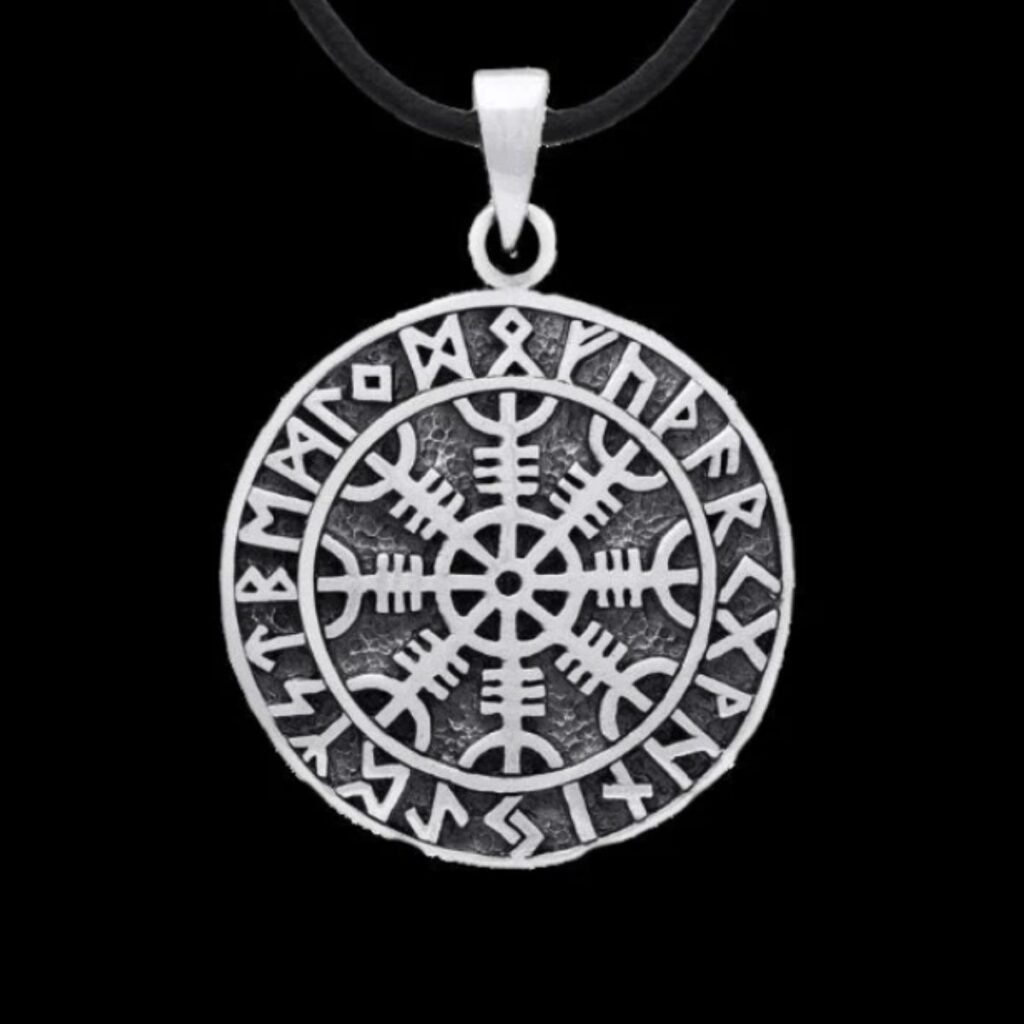
This simple sterling silver Aegishjalmr necklace amulet is the perfect way to carry this potent symbol with you every day.
The circle of runes around the outside connects the magical stave with the Futhark runes used by the Vikings and venerated for their magical properties.
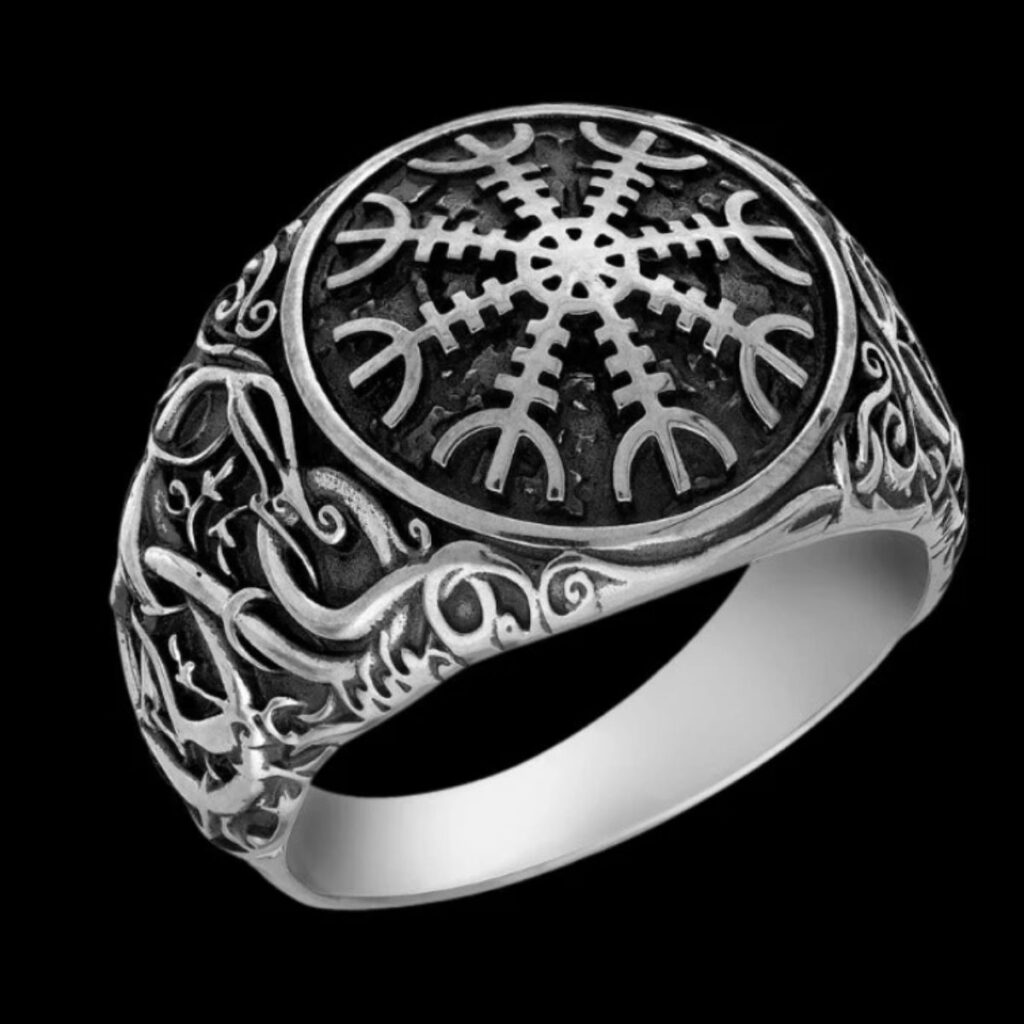
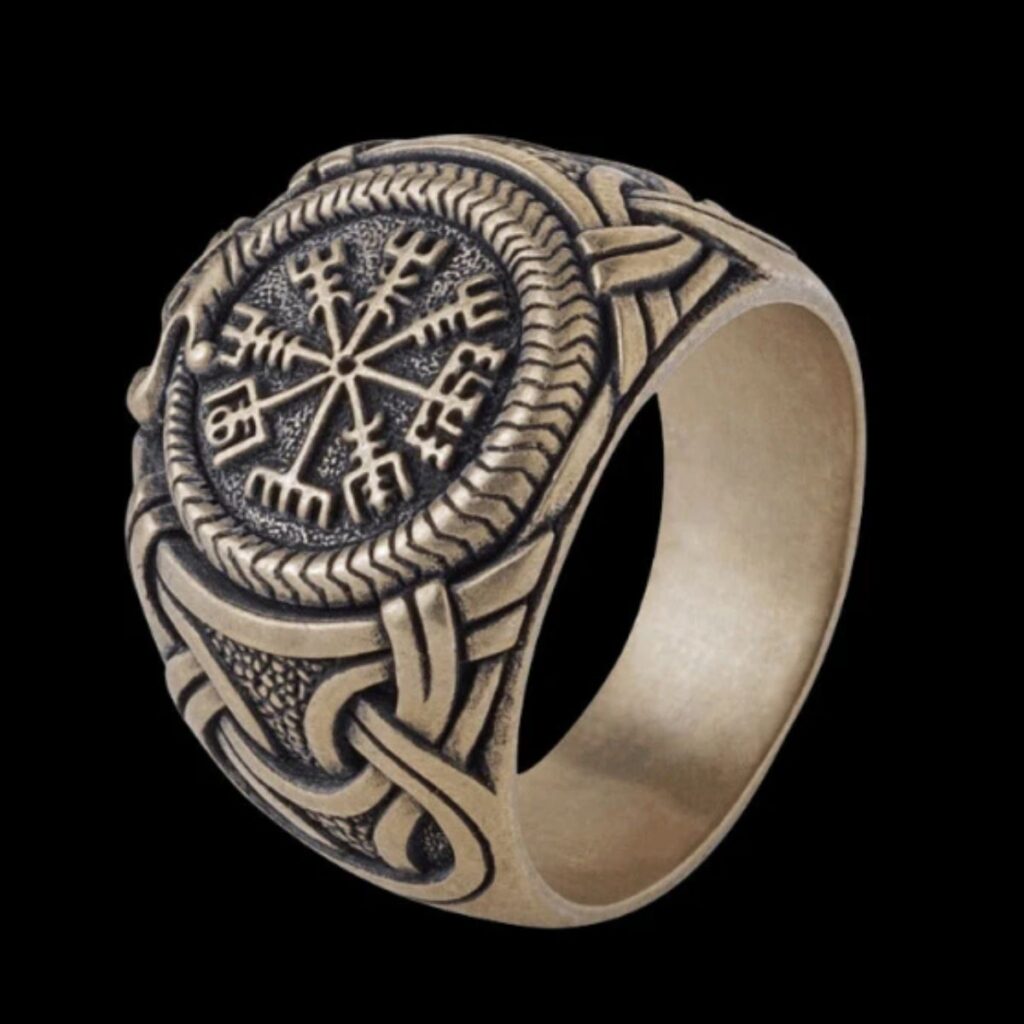
This signet ring is a great way to adopt Aegishjalmr as your personal symbol.
The band is decorated with twirling branches in authentic Norse Urnes style. It is also a nod to Yggdrasil, the source of the Viking runes.
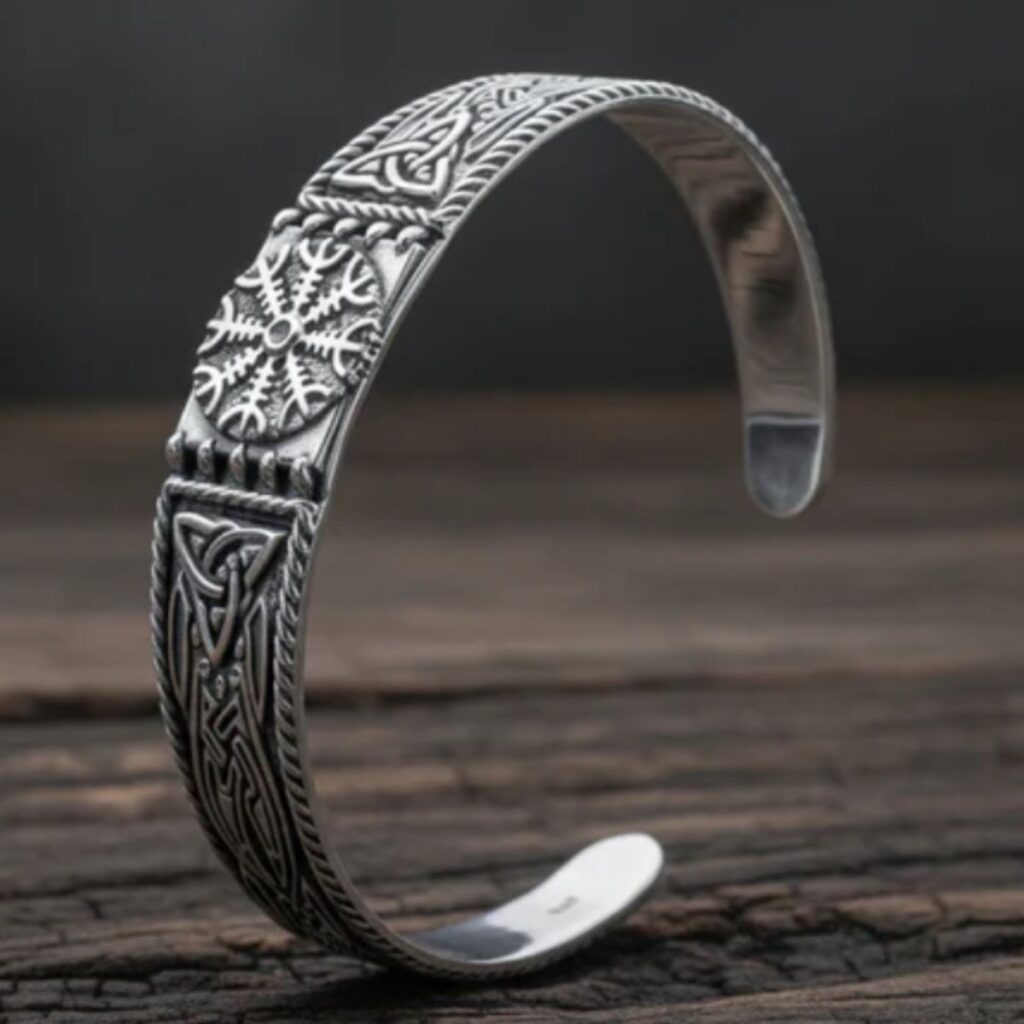
The Vikings wore arm rings as symbols of loyalty and belonging. Chiefs gave arm rings to their warriors as symbols of mutual trust and respect.
Both arm rings (available in silver and bronze) and the Helm of Awe are perfect choices for a modern Viking.
We love the way this ring combines the Helm of Awe with a Norse dragon in a reference to Fafnir and his possession of the Helm of Awe.
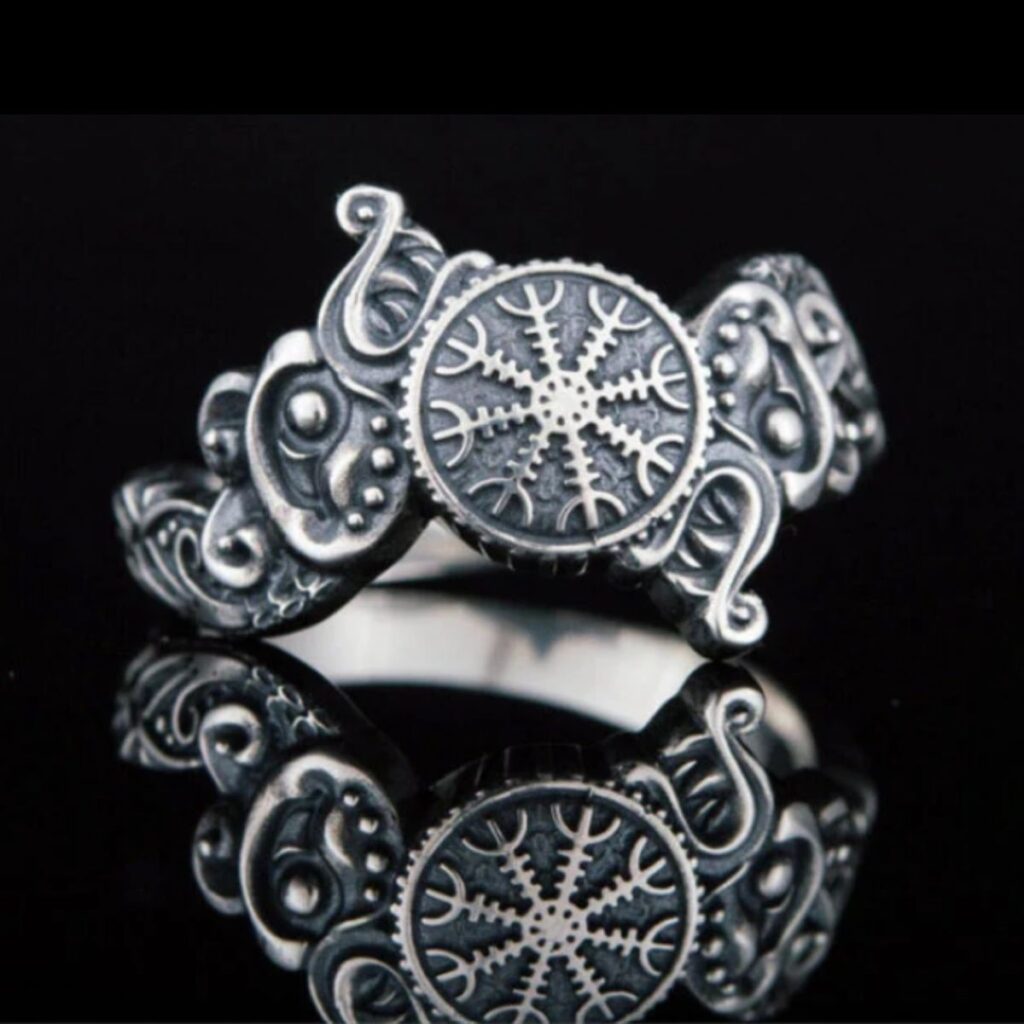

The simplicity of this hand-carved ring is compelling. It feels like exactly how a Viking would have created a Helm of Awe before going into battle to boost their strength and bravery.
This stunning bronze signet ring is the perfect way to carry this symbol with you wherever you go. Always have the guidance of the gods.
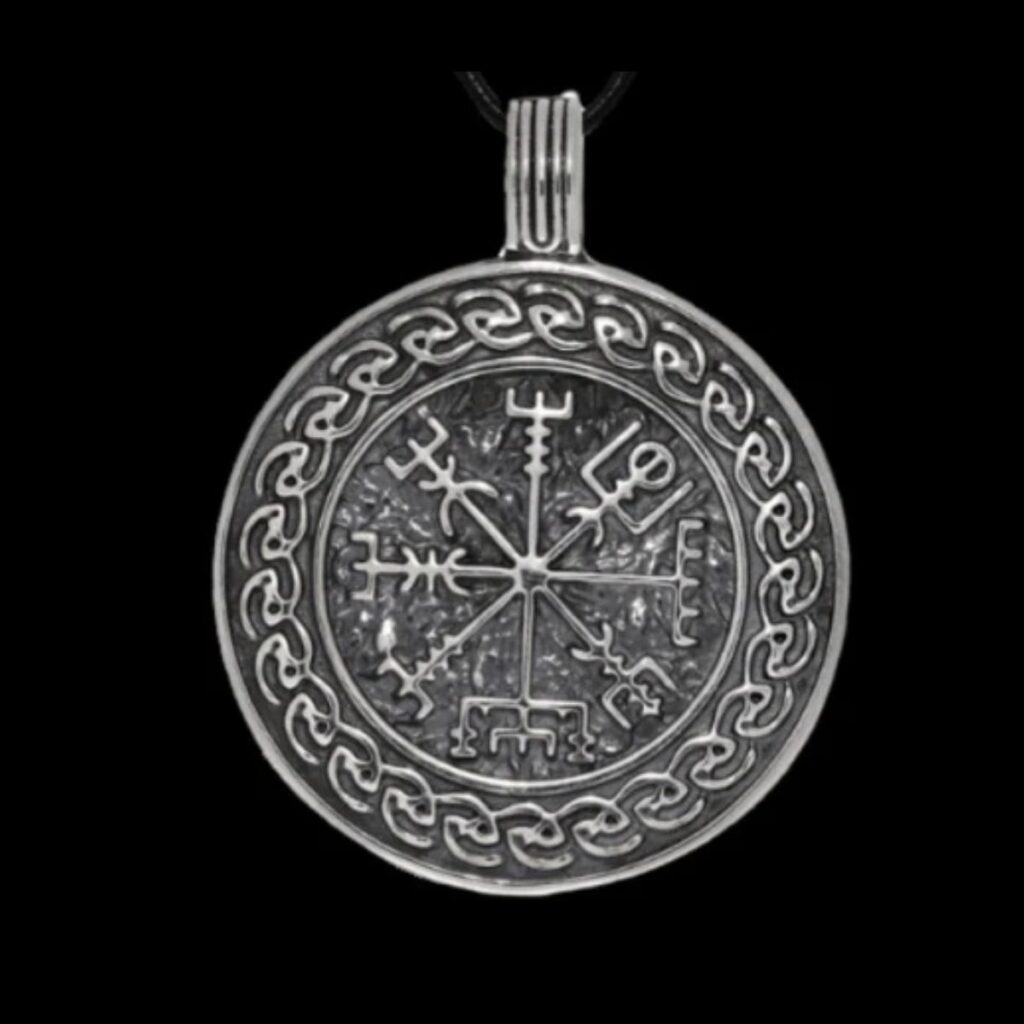
This sterling silver pendant feels like how the Vikings may have carried this symbol. They preferred amulets rather than rings when it came to jewelry.
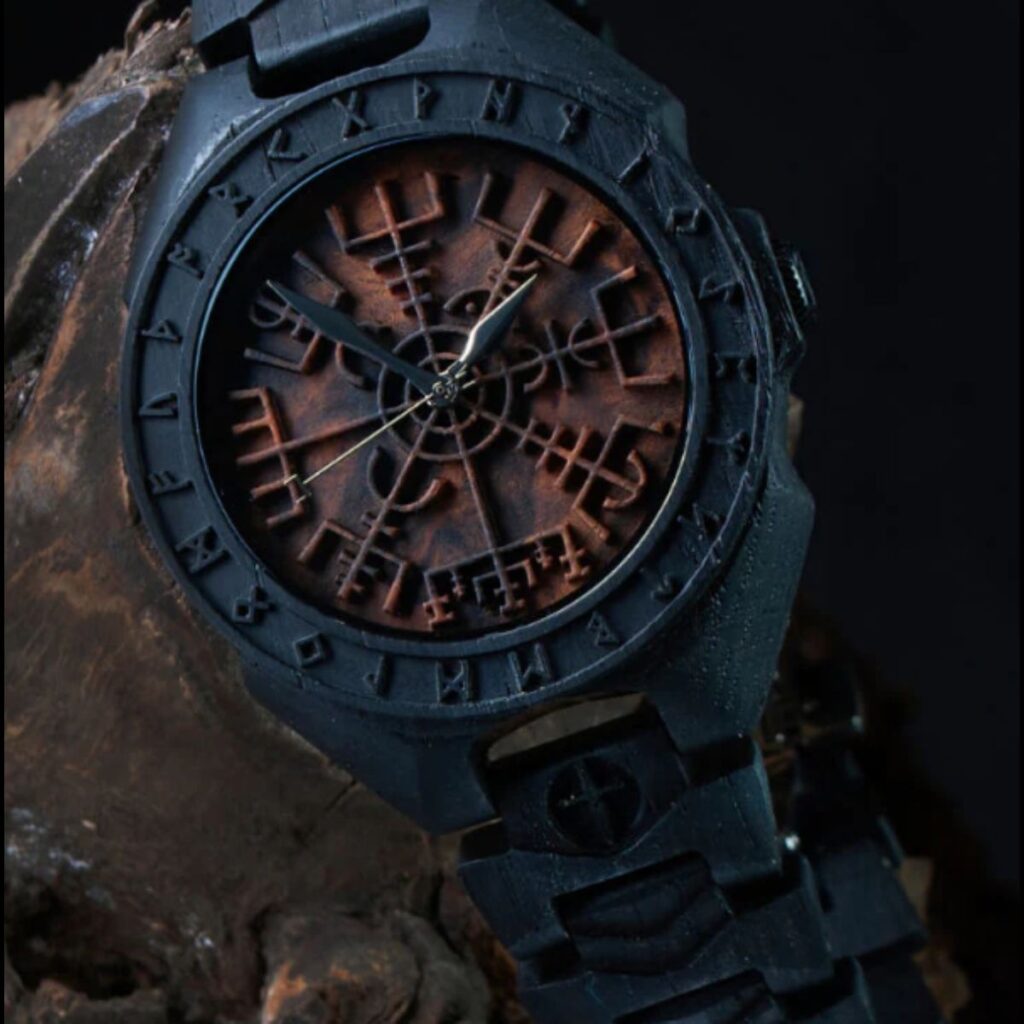
Remind yourself that the Norse gods are guiding you every time you check the time.

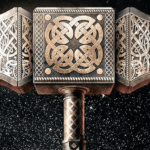
Combine a symbol of divine protection, Thor’s Hammer Mjolnir, with a symbol of divine guidance on the handle. The goats on the hammer head represent the goats that puled Thor’s chariot, Tanngrisnir (Teeth-grinder) and Tanngnjóstr (Teeth-bearer).
This bronze pendant places Vegvisir within a circle of runes, a reminder of the power that underlies the Gladrastafir. Two wolf heads sit at the top of the pendent, a reminder of the strong natural forces that we battle each day.


This arm ring combines Thor’s Hammer, Mjolnir, a symbol of protection, with the Norse Futhark runes. Th inscription reads “hail Odin,” the chief Norse god, who also discovered the runes.
This silver ring features the Algiz rune, which had the phonetic sound Z and the symbolic meaning of protection. It is the rune that is repeated to create Aegishjalmur.


A simple pendant featuring the Tiwaz rune. Associated with the god Tyr, as well as the letter T, it represents courage, bravery, strength, and a sense of justice.
This hair or beard bead features a strip of Norse runes and is ideal for creating a quintessential Viking hairstyle.


This gold ring shows the runes inscribed on a pattern of bark, symbolic of the runes carved into the bark of Yggdrasil to create destiny.
FAQs
What was the primary purpose of Viking runestones?
Runestones were monumental stone markers raised across the Viking world, primarily serving as memorials to honor deceased individuals. Many were originally decorated with bright paint and occasionally incorporated legal property records, skaldic verse, or spiritual imagery.
How many Viking runestones survive today and where are they located?
Sweden preserves the vast majority with around 2,500 surviving runestones, while Denmark accounts for approximately 260. Norway and the British Isles each preserve around 50 additional surviving stones.
Why is the Rök Runestone historically significant?
It features the longest surviving runic inscription in stone, containing roughly 760 characters carved across five sides. Raised by Varinn in memory of his son, the text preserves complex ciphers, riddles, skaldic verse, and references to heroic myths such as Theodoric the Great.
Why is the Greater Jelling Stone referred to as Denmark’s birth certificate?
King Harald Bluetooth raised the stone to proclaim his unification of Denmark and Norway alongside his official Christianization of the Danes. The monument also displays the earliest surviving depiction of Jesus Christ in Scandinavia, framed in Mammen-style knotwork.
What makes the Kuli Stone historically important to Norway?
Often described as Norway’s birth certificate, the stone preserves the earliest native appearance of the name “Norway” (Nóregr) on Norwegian soil. Its inscription also provides an explicit historical benchmark by noting that Christianity had been established in Norway for twelve winters.
What distinguishes the Kingittorsuaq Runestone from other Viking finds?
Discovered at 72°55′ N in Baffin Bay, Greenland, it stands as the northernmost genuine Norse runic monument ever recovered. Left by three hunters around the year 1300, it provides physical evidence of the immense geographic range of Arctic voyages undertaken by the Greenland Norse.
Did the Vikings believe runestones possessed magical properties?
Norse culture regarded runes as sacred symbols gifted by Odin that could be used for spells, protective wards, and curses. Monuments such as the Kylver and Stentoften stones were placed face-down over burials to prevent the dead from rising or to threaten grave violators.