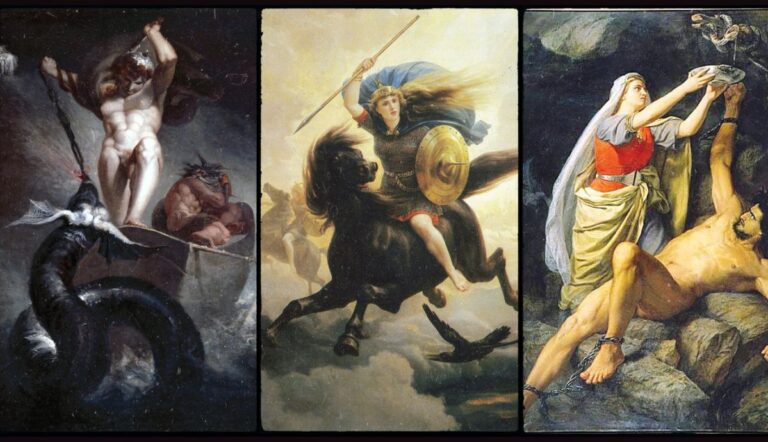
The way we envision the Vikings today has been greatly influenced by paintings composed centuries later during the Scandinavian Romantic Nationalism of the 18th and 19th centuries. In this period, artists looked to Norse mythology and the Norse Sagas for inspiration, inserting their own ideas, such as warriors in horned helmets and shieldmaidens as Greek goddesses, none of which would have made sense in the Viking Age.
While these paintings may not be historically accurate, they are certainly inspiring and have shaped modern perceptions of the Vikings. Below are nine of the most important and stunning paintings about the Vikings and Norse mythology.
1. Åsgårdsreien (The Wild Hunt of Odin) – Peter Nicolai Arbo (1872)
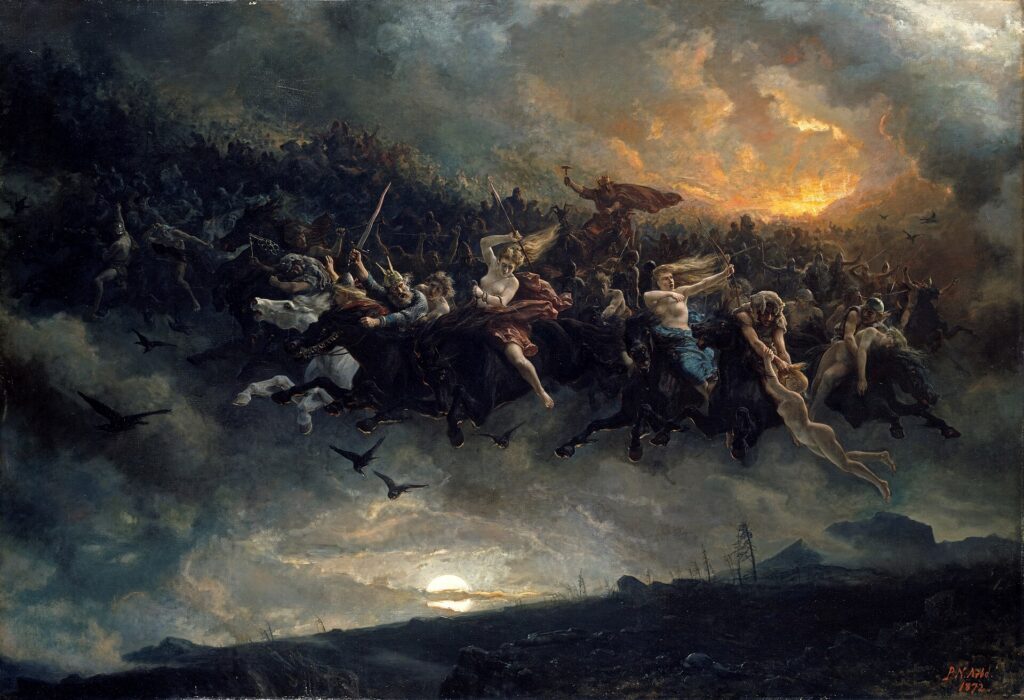
Location: National Museum of Art, Architecture and Design, Oslo, Norway
Peter Nicolai Arbo (1831-1892) was a prominent Norwegian painter in the Scandinavian Romantic Nationalist movement. While most of his contemporaries focused on grand fjord and mountain landscapes, Arbo looked to the sagas and folklore for inspiration.
His depiction of the Wild Hunt is widely regarded as the defining visual masterpiece of Norse folklore. This was a supernatural hunt led by the god Odin, usually around Yule in the depth of winter. While it was not a malicious hunt, it was extremely dangerous to get caught in its path.
Rather than connecting directly with the folklore, Arbo’s painting was inspired by Johan Sebastian Welhaven’s 1844 romantic poem Åsgårdsreien. The riders move in a strong, downward diagonal direction to make it appear that they are descending on the viewer. Except for Odin, who rides a white horse, the image shows a mass of black horses in chaos as the riders carry spears, bows, and torches. Thor accompanies Odin in a chariot pulled by goats, holding his hammer Mjolnir, and the Valkyries, the shieldmaidens of Asgard, are also clearly present. Odin’s ravens accompany the party.
2. Valkyrien (Valkyrie) – Peter Nicolai Arbo (1864 / 1869)
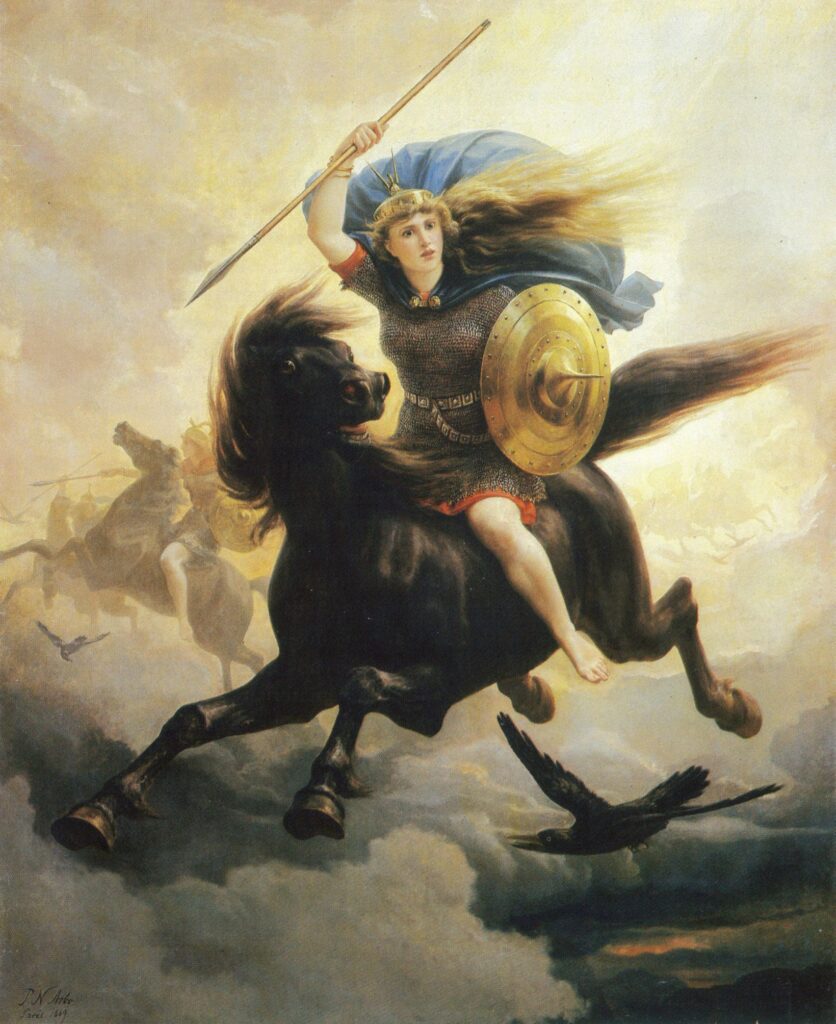
Location: National Museum, Oslo / Stockholm
Arbo also composed an image of a Valkyrie, which established the archetypal image of a romantic Valkyrie. He created two large oil canvases of the composition, one currently in Sweden (1864) and the other in Norway (1869).
The Valkyrie charges across the sky, seemingly to claim the souls of brave fallen warriors to take to Odin’s afterlife of Valhalla. She is not an aloof spirit, but a tangible female warrior with a round shield and raised spear. Her billowing blond hair gives the impression of swift movement.
This image reset earlier neoclassical images of the Valkyries as Greek goddesses, winged nymphs, or allegorical muses, giving them a visceral presence more appropriate for the divine Norse shieldmaidens.
3. Thor’s Fight with the Giants (Tors strid med jättarna) – Mårten Eskil Winge (1872)
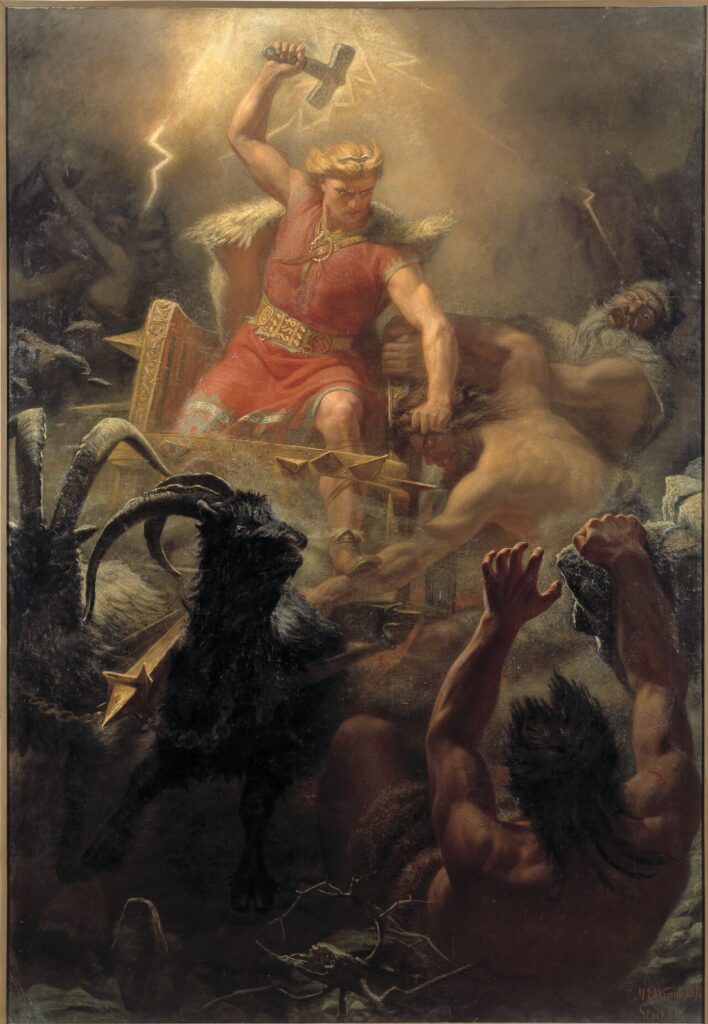
Location: Nationalmuseum, Stockholm, Sweden
This painting is one of the most reproduced images of Thor, the god of thunder in Norse mythology. Standing in his famous chariot drawn by goats, he wields the hammer Mjolnir to smite the giants around him, producing lightning and thunder as he strikes.
Mårten Eskil Winge (1825–1896) was a prominent Swedish painter. This work was displayed at the Royal Academy exhibition in Stockholm in 1872 and caused an immediate public sensation. It was hailed as a triumphant expression of Swedish identity and the reclamation of ancient Scandinavian mythology from centuries of Greco-Roman artistic dominance.
4. Thor Battering the Midgard Serpent – Henry Fuseli (1790)
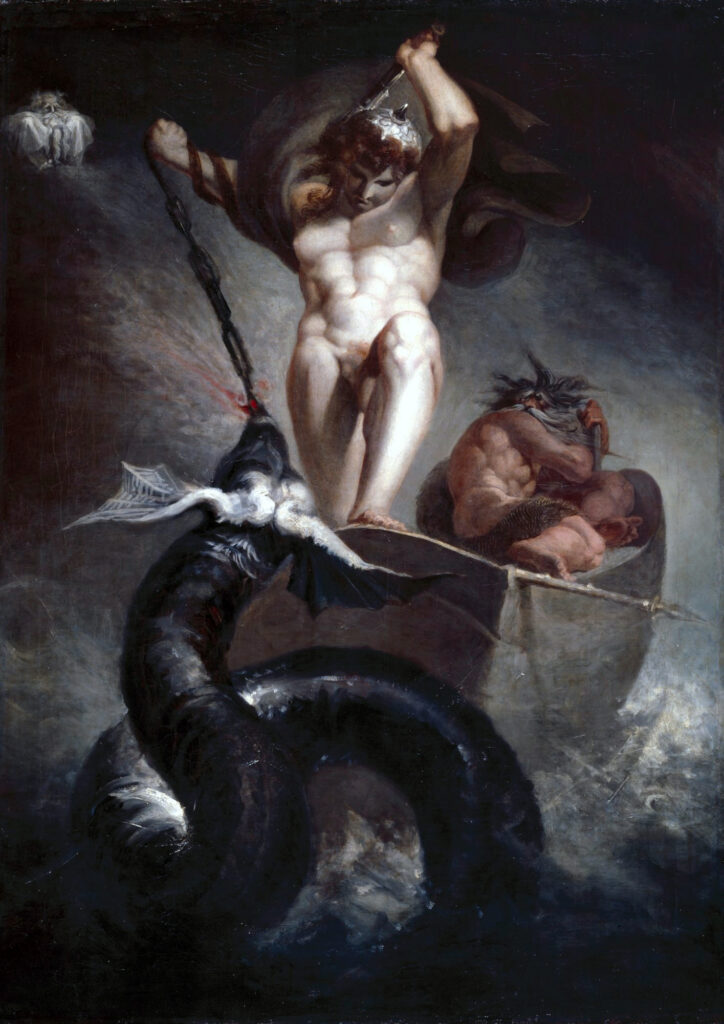
Location: Royal Academy of Arts, London
Thor Battering the Midgard Serpent is one of the earliest and most dramatic depictions of Norse mythology in modern Western art. Henry Fuseli submitted the massive oil painting as his Diploma Work upon being elected a full Royal Academician; it remains preserved in the Royal Academy of Arts collection in London.
It is a scene from the story of Thor’s Fishing Trip in which he went fishing with the giant Hymir and used ox heads as bait to try and catch the Midgard Serpent, Jormungandr. The two are meant to kill one another at Ragnarok, so Hymir feared that their encounter would trigger the apocalypse. When Thor had the serpent on the hook, Hymir cut the line to prevent the confrontation.
5. Loke och Sigyn (Loki and Sigyn) – Mårten Eskil Winge (1863)
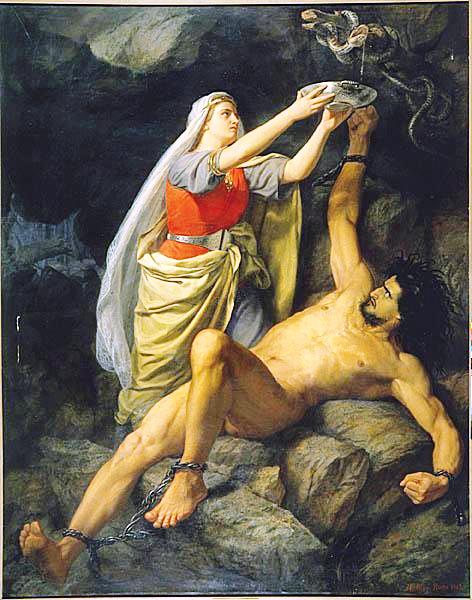
Location: Nationalmuseum, Stockholm, Sweden
In this work, Winge depicts the punishment of Loki for his role in the death of the god Balder. The gods chained Loki to rocks and hung a venomous serpent over him to painfully drip poison onto his body. His wife Sigyn stays by his side with a bowl to capture the venom and spare him the pain, but she must occasionally leave to empty her bowl, leaving Loki to suffer.
Winge contrasts Loki, a giant, as a chaotic figure, semi-nude with a rugged beard and tense muscles. Sigyn, an Aesir goddess, is ethereal in classical drapery with a tranquil if solemn appearance.
6. Heimdall Returns Brísingamen to Freyja – Nils Blommér (1846)
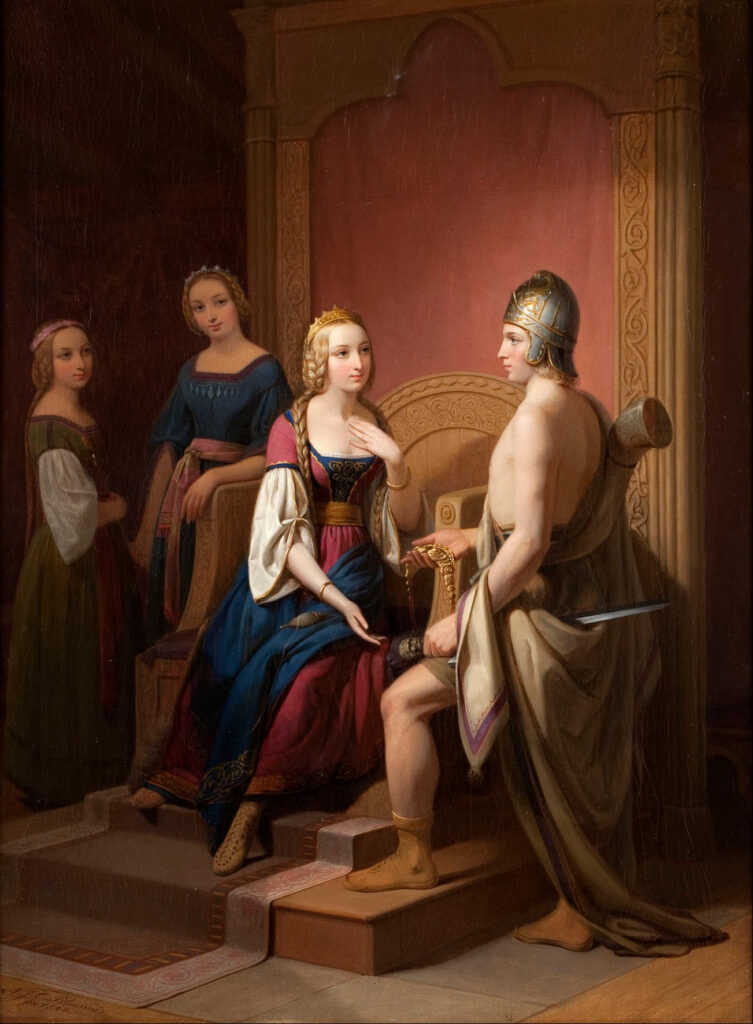
Location: Malmö Konstmuseum, Sweden
The painting illustrates an episode preserved in the skaldic poem Húsdrápa and cited in Snorri Sturluson’s Prose Edda. The goddess Freyja’s prized possession, the luminous golden necklace Brísingamen, was stolen from her chamber by the trickster Loki. Heimdall, the watchman of Asgard, saw the theft and tracked down Loki. The two did battle in the form of seals. Heimdall won and returned the necklace to Freyja.
Nile Blommér captures the tranquil aftermath rather than the violent combat. Heimdall visits Freyja’s hall, Fólkvangr, to restore the treasure to its rightful owner. Freyja, seated on an ornate high seat with her attendants nearby, reaches out with one hand while pressing the other to her chest in relief and gratitude as Heimdall extends the glittering chain.
7. A Viking Funeral – Frank Dicksee (1893)
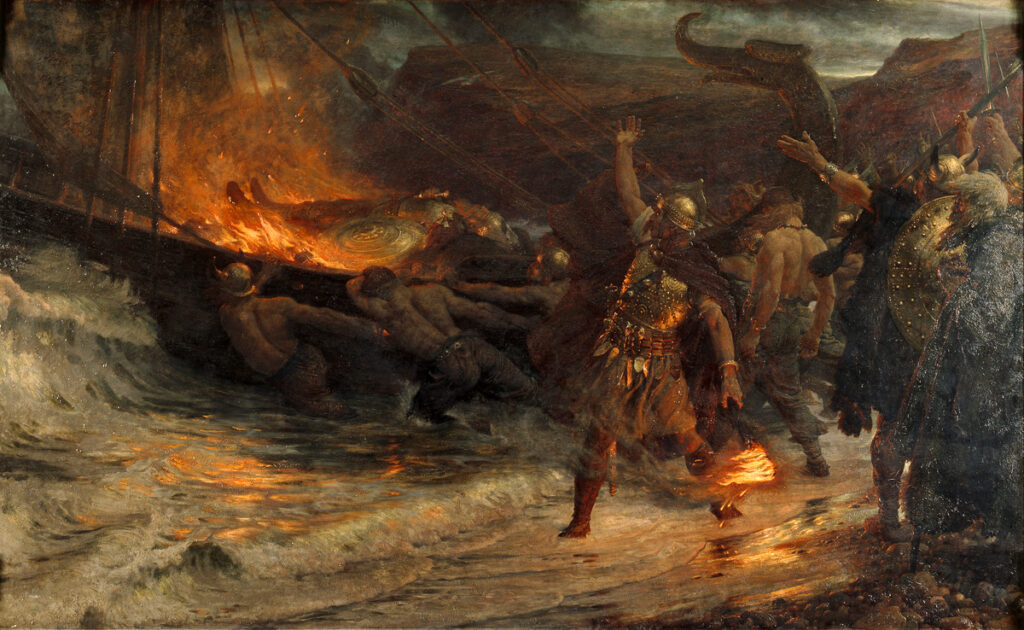
Location: Manchester Art Gallery, UK
This painting shows a romanticized ship burial in which a slain chieftain is burned in a ship pyre at sea. The ship has an ornate dragon prow, a common feature of dakkar ships. The Viking chief is in full armor with his shield resting beside him as the flame slowly engulfs him. Comrades and warriors push the ship into the water while a ritual leader in a winged helmet and chainmail carries the torch.
While ship burials were an authentic Scandinavian practice during the Viking Age, as proven by discoveries like the Oseberg and Gokstad ships, setting a ship on fire while letting it drift out to sea was largely an idealized literary trope popular in Victorian Britain and 19th-century Scandinavia. Dicksee was a London born artist best known for his images of Arthurian legends.
8. Ingeborg Receiving the News of Hjalmar’s Death – August Malmström (1859)
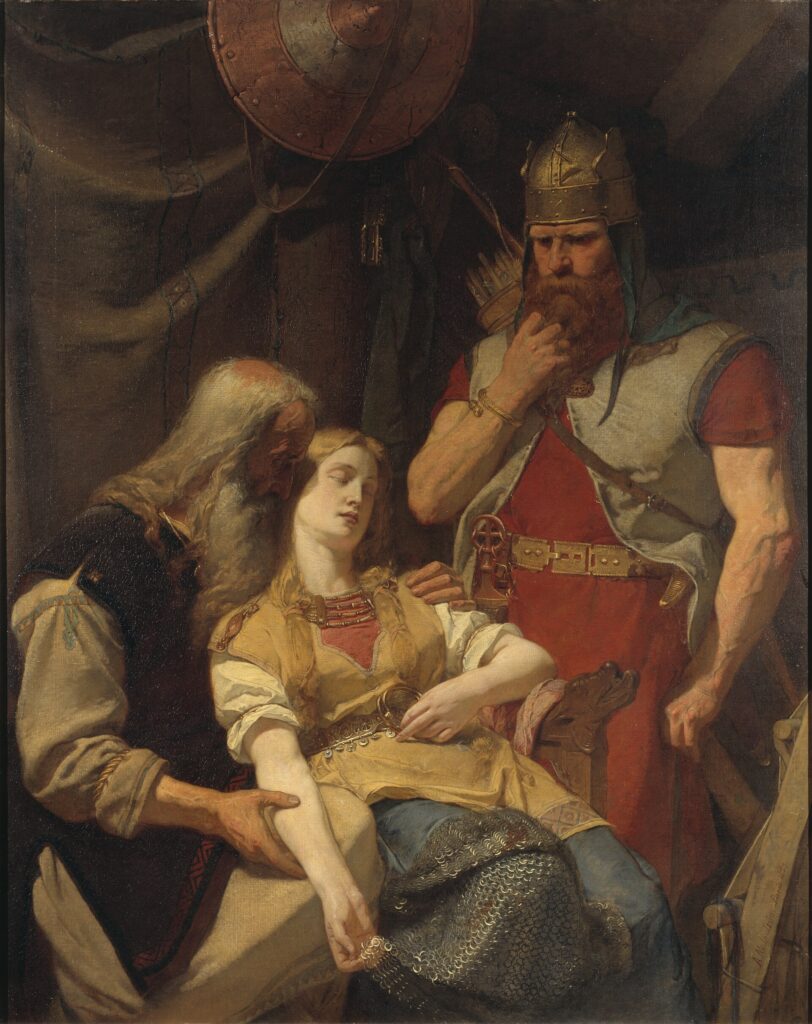
Location: Nationalmuseum, Stockholm
This painting by the Swedish artist draws its narrative from the legend of Hjalmar the Haughty, a famed Swedish champion. He fell in love with Princess Ingeborg, daughter of King Yngvi. Although Ingeborg returned his love, her father refused Hjalmar’s proposal, eventually promising her instead to the fearsome berserker Angantyr.
Hjalmar and his blood-brother, the legendary hero Örvar-Odd, traveled to the Danish island of Samsø to face Angantyr and his eleven berserker brothers. Though Hjalmar and Odd prevailed and slew all twelve foes, Hjalmar suffered fatal wounds from Angantyr’s cursed sword, Tyrfing. As he lay dying, Hjalmar sang a farewell song and charged Örvar-Odd to bring his ring back to Ingeborg in Uppsala. In the saga’s climactic tragedy, upon receiving Hjalmar’s ring and hearing the tidings of his death, Ingeborg collapsed and died of a broken heart on the spot.
9. The Guests from Overseas – Nicholas Roerich (1901)
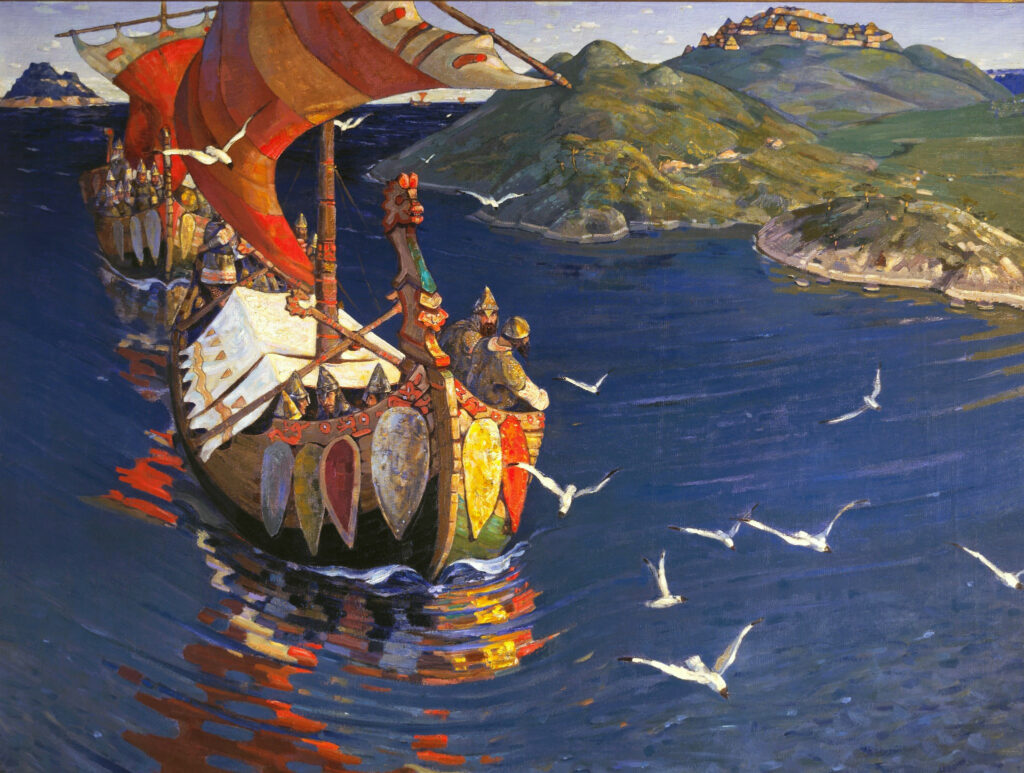
Location: Tretyakov Gallery, Moscow
Nicholas Roerich was a Russian artist and philosopher who captured medieval contact between the Scandinavian Norsemen and the Slavic world. It is an evocative and vibrant portrayal of Norse Varangians arriving in Kievan Rus’ on their way to the Byzantine Empire. Painted with bold, rhythmic colors, it showcases ornate Viking dragon ships sailing along Russian waterways, capturing trade, exploration, and cultural fusion.
Unlike many 19th-century Romantics who invented purely theatrical fantasy gear, Roerich was an active field archaeologist who excavated Slavic and Norse burial mounds around St. Petersburg and Novgorod. He infused the piece with firsthand knowledge of ancient boat construction, shields, and fortified settlements.
Historical Replicas in the VKNG Collection
Are you inspired by Nordic history? You might also love by some of our jewellery of the past, including many pieces inspired by genuine archaeological finds from the Viking world.
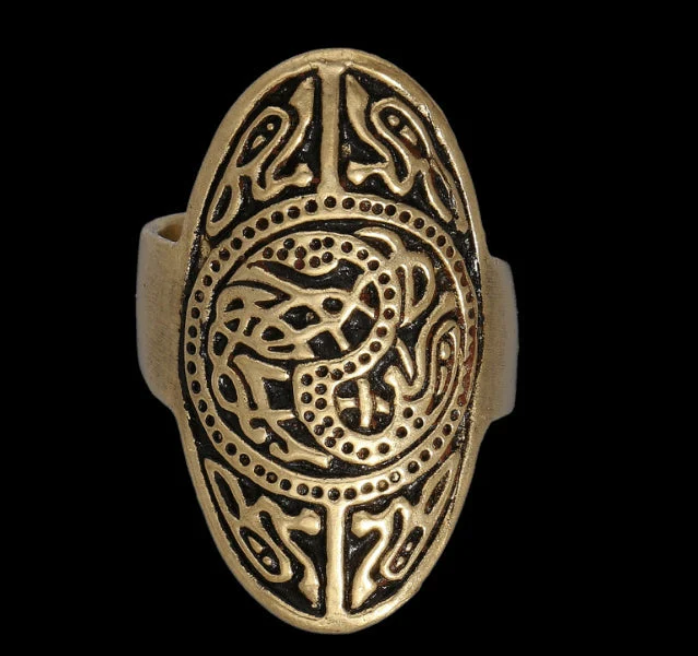
This handcrafted bronze ring is based on an Anglo-Saxon ring found in the Thames River. It reflects the coming together of Anglo-Saxon and Norse cultures in the 10th and 11th centuries, featuring Nordic-style zoomorphic patterns.
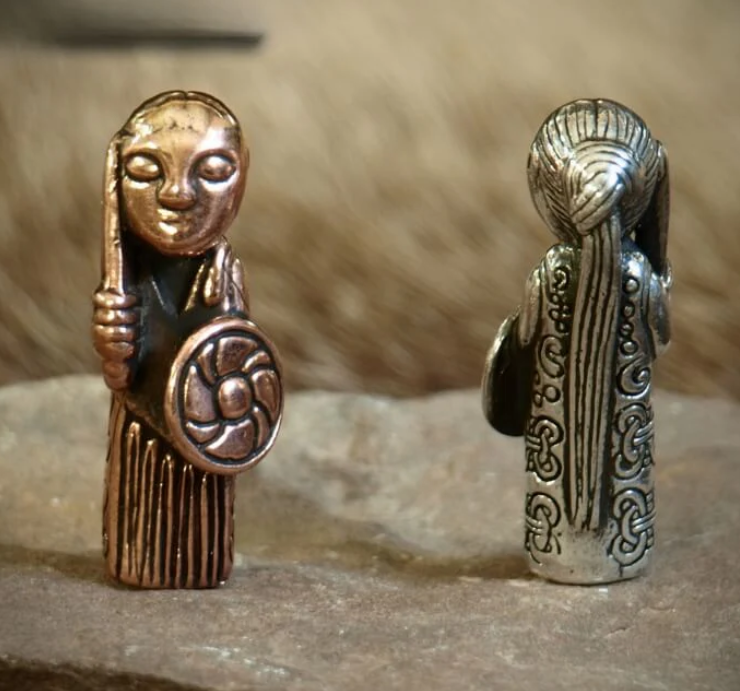
This pendant, available in bronze or silver, depicts a Viking shieldmaiden, probably one of the divine Valkyrie. It is based on a small silver figure found at Harby in Denmark.
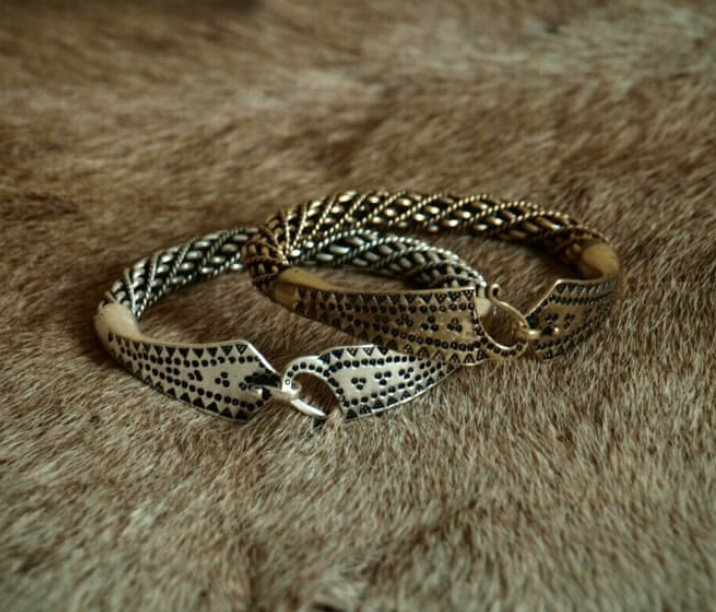
These stunning bronze bracelets with Norse geometric designs are copies of pieces found in the Vulum Hoard, Norway, dating to the 10th or 11th century.
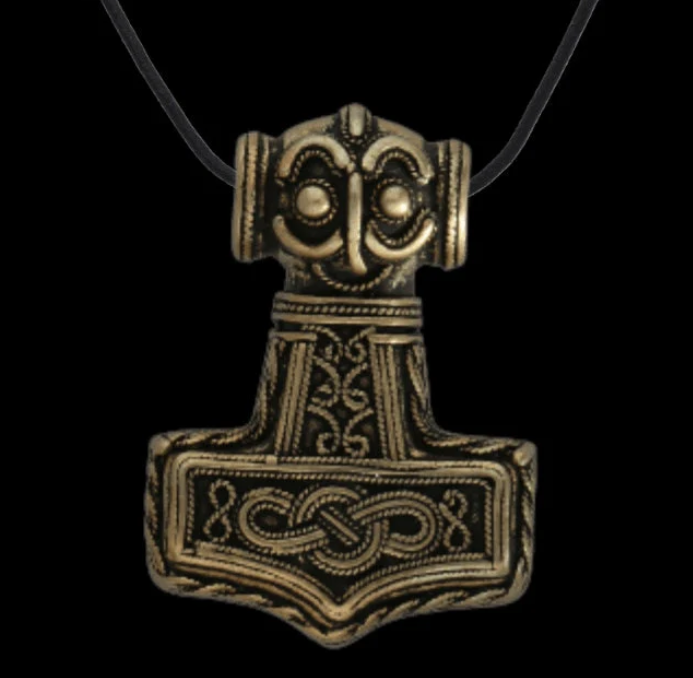
This bronze Thor’s hammer pendant is inspired by a Mjolnir amulet found at Odeshog in Sweden. Pendants like this were worn as a symbol of the protection of the Norse gods.