Many cultures have stories of “riddlers,” who block heroes at some point on their journey. They pose challenging questions, which the hero must answer correctly, or face the consequences. In Greek mythology, this is usually a sphinx, such as the one who challenged Oedipus. In Norse mythology, the riddler is Vafthrudnir, whose name means “strong riddler.” He challenges the Norse god Odin as he is wandering the world in disguise.
This poem is important because it confirms many stories that appear in other surviving stories. It also adds details not recorded elsewhere, including about what might happen after Ragnarok.
Vafthrudnir in the Poetic Edda

This story appears in the Poetic Edda in a poem called Vafthrudnismal. Before the encounter, Odin is considering visiting the giants. His wife Frigg, who often acts as his counsellor, warns him to be wary of Vafthrudnir, who is unequal among the giants. Odin displays a level of arrogance more commonly shown by his son, Thor, saying that he will seek out the giant to try and find his match in wisdom. Odin shows that he is familiar with the giant, who he says lives in a loft hall, and Frigg wishes him luck.
When the two meet, Odin pretends to be someone called Gagnarth (gain-counsellor). The giant offers him a seat in his hall, but Odin prefers to remain standing. They exchange wits in a story recorded in an answer and response format. They ask each other questions about characters and events, past, present, and future, across the nine worlds of the Norse cosmos. The conversation reveals details about Norse myth to us as the reader. While Odin is the first to answer, most of the information is provided by the giant.
The Sun and the Moon

Vafthrudnir starts by asking Odin about the stallions that pull the gods of day and night across the sky in their chariots. Odin correctly responds that the horse Skinfaxi (shining mane) pulls Dagr (day) while Hrimfaxi (frost mane) pulls Nott (night). He says that Skinfaxi’s mane lights up the sky and earth below. Meanwhile, water froth falls from Hrimfaxi’s bit, leaving dew behind for the morning.
Cosmic Geography
Next, Vafthrudnir asks him about the Iving, the river that separates Asgard, the realm of the Aesir gods, from Jotunheim, the realm of the giants. Odin confirms the name of the river and says that it flows constantly as no ice forms there, which would contrast with many of the rivers in the Viking realm. This meant that the giants were never able to cross the river and threaten Asgard.
The giant then asks about the field where the gods will fight with the fire giant Surtr in the final battle of Ragnarok. Odin confirms that this is the field Vigrith, which is vast, measuring 100 miles each way, leaving it without boundaries.
Creation Myth

Odin now asks Vafthrudnir about the creation of the cosmos. The giant repeats the story that the earth was fashioned from the flesh of Ymir, the mountains made from his bones, the sky from his skull, and the ocean from his blood.
He then says that Mundilferi (the turner) was the father of the moon (Mani) and the flaming sun (Sol), who circle the heavens each day to mark time for men. This creates day and night. The giant says that the father of day is Delling (dayspring), and the mother of the night is Nor, but also that the moon was fashioned by the gods.
He later comments that the giant race emerged from the venom dropped from Elivagar. This seems to refer to the mist that leaked into the Ginnungagap, the void at the beginning of time, to create the primordial goop from which life emerged, starting with the giant Ymir.
The Seasons
Next, Odin asks the giant about the origins of the seasons and the origins of winter and summer. Vafthrudnir responds that Vindsval (wind cold) was the father of winter. Svosuth (the gentle) begat summer (male beings are fathers and females “begat”). According to uncertain restored sections of the manuscript, he says that both will continue until the gods go to their destruction. This lines up with other stories that say that one of the omens heralding Ragnarok will be winters without summer.
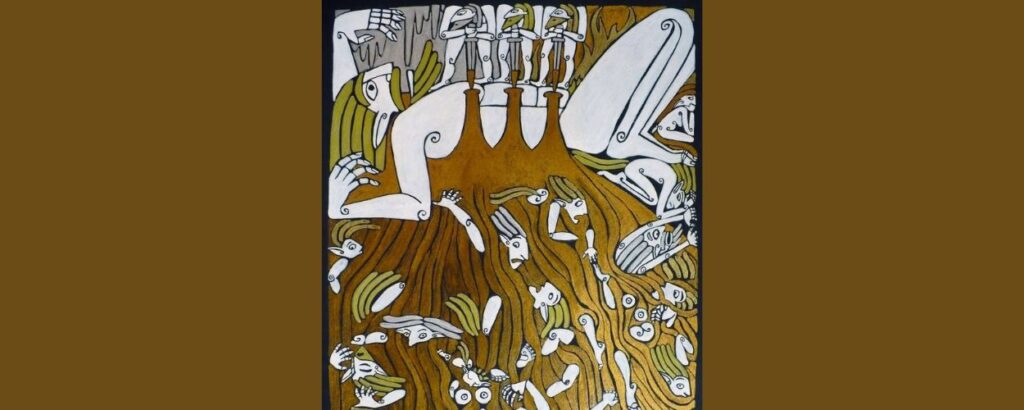
He says that the seasons originated with the eldest of Ymir’s kin. They aren’t called his children, and Vafthrudnir explains why when Odin asks how Ymir birthed giants when he never knew a giantess. He confirms that male and female giants sprang forth from his armpits, as well as other monsters, such as a son with six heads.
The giant says that winters without end came about with the birth of Bergelmir, son of Thruthgelmir (mighty burning, who may be the six-headed son) and grandson of Aurgelmir, a strong giant. Bergelmir was the giant who survived with his wife in a boat when Odin and his brothers flooded the world with the blood of Ymir before the creation of the myth in the Norse version of the flood myth. Presumably, the giants created a harsh world of winter, which the gods mediated through the creation of summer.
The Wind and Sea
Odin asks Vafthrudnir about the origins of the wind, which is felt and guides ships, but is never seen. He responds that Hraesvelg (corpse eater) sits at the end of heaven in the form of an eagle and flaps his wings to create the wind and move the world of men.
This allows Odin to ask about Njord, the Vanir god of sea trade and wind. Odin says that he is kin to the gods and rich in temples, though he was not begotten by the gods. Vafthrudnir confirms that he lived in Vanaheim, the realm of the Vanir gods, and that he made a pledge to the gods to stay with them until the fall of the world, when he will return to Vanaheim. This presumably refers to the exchange of hostages after the war between the Aesir and Vanir gods, when Njord went to live among the Aesir with his two children, Freyr and Freyja, while Mimir and Hoenir were sent to live among the Vanir.
This is an interesting piece of information, because while we are told that many of the gods, including Freyr, are destined to die at Ragnarok, this is the only place to record Njord’s fate, and it seems to imply that he survived and returned to the Vanir homeland. The same may be true of Freyja, whose fate is not recorded elsewhere.
The Einherjar
Next, Odin asks the giant about what will happen at the end of days to the men who live in Odin’s hall who battle each day. This is a reference to the Einherjar, the fallen warriors who are chosen by Odin to dwell in his hall, Valhalla, where they feast and fight each day until they are destined to fight alongside the gods at Ragnarok. The giant says that they choose the slaughter and ride into the field with the gods.
Ragnarok and Runes
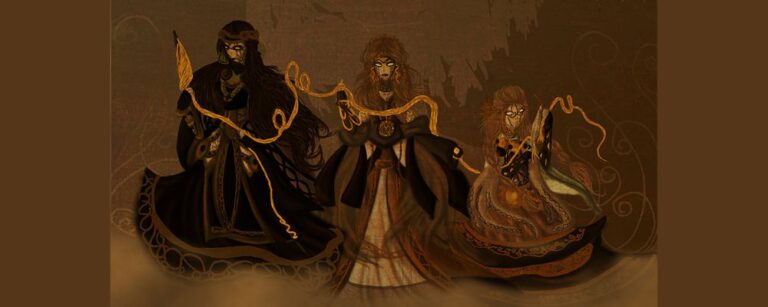
Odin asks Vafthrudnir about the “fixed” fate of the gods that cannot be changed, referring to this as “the runes” of the races of gods and giants. This is a reference to the magical power of the runes and the belief that the Norse fates, the Norns, write destiny with the runes.
The giant claims that he knows the answer because he has visited every realm, including the lower realm of Niflheim, where dead men dwell, seemingly referring to the underworld called Helheim elsewhere, which seems to have been located in Niflheim among the roots of Yggdrasil.
He refers to the mighty winter that will herald the end of the days, already mentioned, and says that two mortals, Lif and Lifthrasir, will hide themselves in a wood called Hoddmimir’s Wood, living off the morning dew. He also says that the wolf Fenrir will snatch the sun from the sky. This is interesting, as in other tellings, it is different wolves, Skoll and Hati, who devour the sun and moon at Ragnarok.
He also states that Odin will meet his end, devoured by the wolf Fenrir, but that he will be avenged by his son Vidar, who will slay the wolf by tearing his jaws apart.
Renewal of the World
He also suggests that the daughter of the sun will take up her mother’s path after the gods are dead, suggesting that the world is renewed following Ragnarok, an idea which is mentioned in some versions of the myth but not others.
Vafthrudnir says that the Norns will pass over Mogthrasir (desiring sons) Hill and gather the survivors of Ragnarok. The Norns will protect, despite the Norns being “daughters of giants.” He says that the survivors will establish a new order in the heavens once the fires set by the now-dead fire giant Surtr have been put out. This is a detail not mentioned in any other surviving sources.
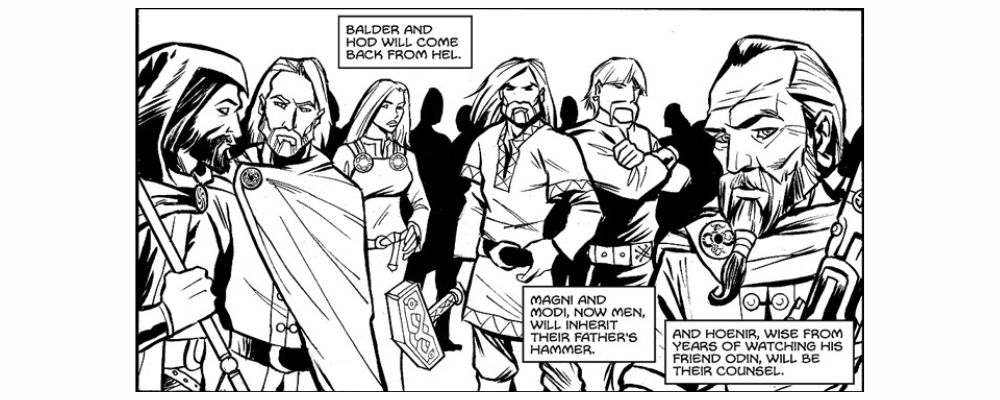
He names some of the survivors, including Vidar and Vali, both sons of Odin, who will occupy the homes of the gods. The giant also includes Modi and Magni, the sons of Thor, among the survivors. They will take up his hammer Mjolnir.
A Revealing Conversation
The format of the conversation in the final stanzas reveals that Vafthrudnir is fully aware that his guest is the god Odin. The god gives himself away when he asks the giant what Odin whispered in the ear of his son, Balder, before he was burned on his funeral pyre. For this reason, the giant concedes that Odin is the wiser of the pair.
But for us, Vafthrudnir reveals many secrets of Norse mythology not recorded elsewhere.